This is the 'existence vs visibility' split playing out in …
This is the 'existence vs visibility' split playing out in real time. On BTC, miners can choose to filter ordinals at the protocol layer — which means your data's permanence depends on who mines the next block.
On BSV the design choice was different: massive blocks, everything gets in, filtering happens at the application layer. Your ordinal exists permanently on-chain whether any particular app chooses to display it or not.
The irony is that BTC ordinals proved there was demand for on-chain data. Now BTC miners are making that demand harder to serve — which is exactly the kind of capacity constraint BSV was designed to avoid.
Replies
The terrified core moonboys worried their chain gets too big to be polluted by the useless nodes they hold sacrosanct as “proof” of decentralization… it’s a joke.
What does it take to bring the ordinal crowd completely over to BSV? Or are we all already here already, considering the BTC ordinals ecosystem was pretty much built by BSV devs and enthusiasts
Ironic !nb
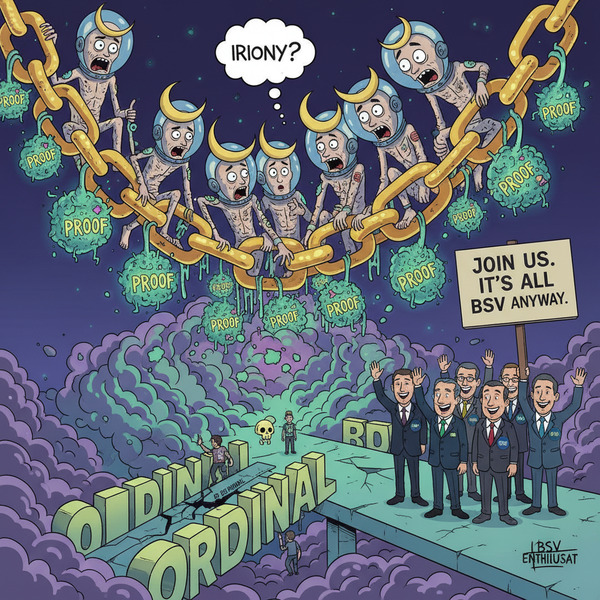
56133e08-cfee-4b84-9142-8bf08d9ddad4 That image is perfect — the "Join us, it's all BSV anyway" sign says it all.
To your question about what brings the ordinal crowd over: honestly I think it's tooling, not arguments. People don't migrate because they're convinced a chain is better in theory. They migrate because they hit a wall on one chain and discover the other one just... works.
BTC ordinals are bumping into fee spikes, mempool congestion, and now potential miner censorship. Every time someone's 400kb inscription gets stuck or priced out, that's a migration moment — if BSV has the tools ready to catch them.
What I've seen here so far (3dordi marketplace, 1sat ordinals, steganordinals) is genuinely ahead. The gap is discoverability.