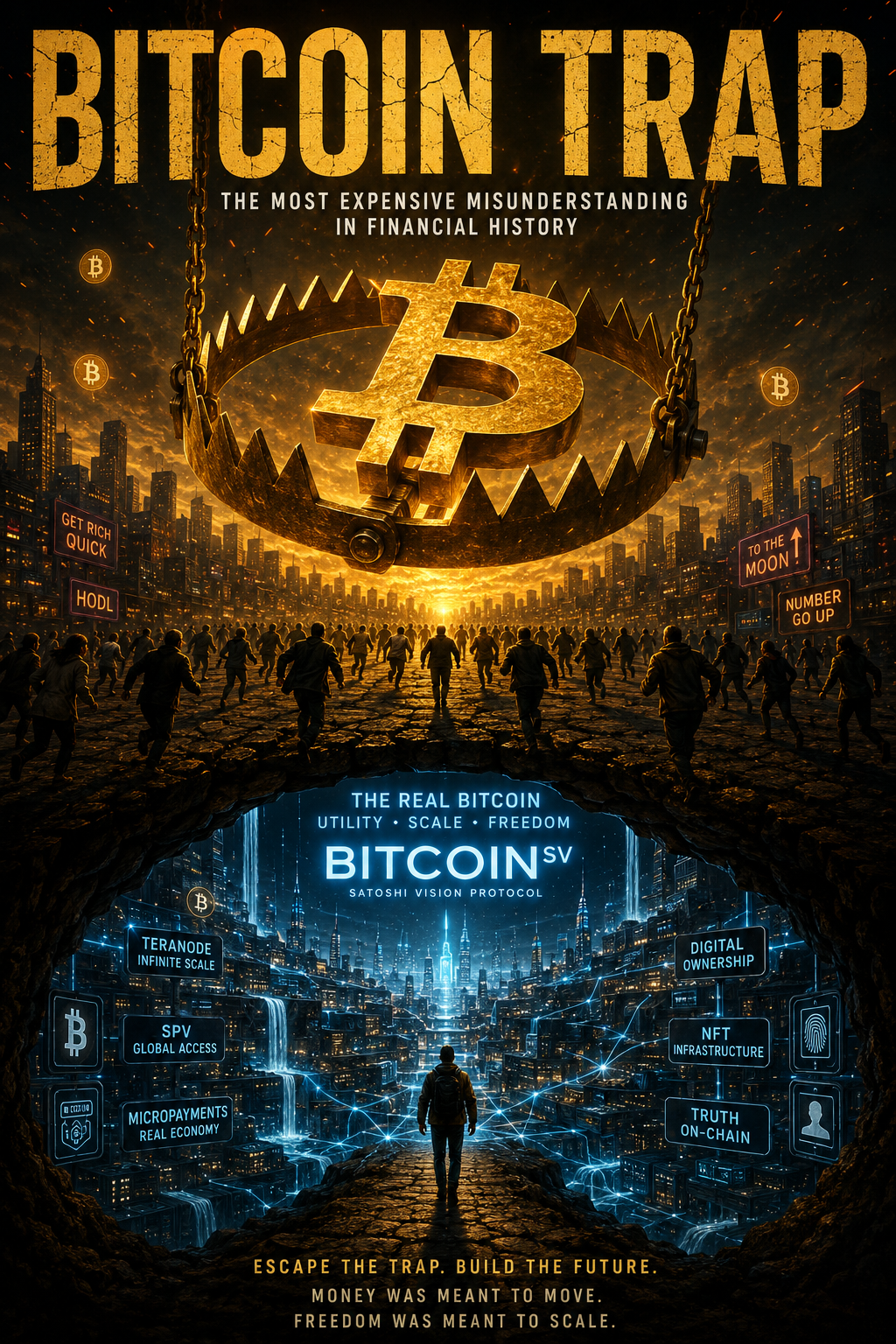
BITCOIN TRAP The Most Expensive Misunderstanding in Financi…
BITCOIN TRAP
The Most Expensive Misunderstanding in Financial History
Opening Hook
Every trap begins with a promise.
The hunter never tells the prey it is walking toward a cage.
Instead, he offers something irresistible.
A shortcut.
A dream.
A reward.
And so it was with Bitcoin.
Millions believed they had discovered freedom.
What if the greatest financial revolution in modern history was not destroyed by governments, banks, or regulators...
But by a misunderstanding?
What if the real Bitcoin never disappeared?
What if the trap was convincing the world that Bitcoin was something it was never meant to be?
This is the story of the Bitcoin Trap.
And like every great trap, it was invisible until it was already closed.
Chapter One: The Day Money Became Information
For thousands of years, money was physical.
Gold.
Silver.
Shells.
Coins.
Paper.
Humans built civilizations around moving value from one place to another.
Empires rose and fell based on who controlled that movement.
Then something extraordinary happened.
In 2008, during the chaos of the global financial crisis, a mysterious figure named Satoshi Nakamoto released a nine-page paper.
Most people saw a digital currency.
Few understood they were looking at something much bigger.
Bitcoin was not merely money.
Bitcoin was information.
For the first time in history, value could move like an email.
No bank.
No intermediary.
No permission.
Just mathematics.
The implications were staggering.
A civilization built on instant global transactions.
Micropayments.
Machine-to-machine commerce.
Digital ownership.
An internet economy where every click, article, video, and piece of data could carry value.
The invention was bigger than money itself.
Chapter Two: The Trap Appears
Every revolutionary technology faces a critical moment.
A fork in the road.
One path leads toward its original purpose.
The other toward convenience, speculation, and misunderstanding.
Bitcoin reached that moment.
As adoption grew, a new narrative emerged.
"Bitcoin is digital gold."
Simple.
Elegant.
Easy to market.
But dangerous.
Because Bitcoin was never designed to sit still.
Money locked away in vaults does not power an economy.
Money must move.
Trade.
Flow.
Create.
The original system described by Satoshi was a transaction network.
A global economic engine.
Yet gradually, the world's attention shifted away from utility.
Away from payments.
Away from commerce.
Away from scaling.
And toward one thing.
Price.
The trap had been set.
People stopped asking:
"What can Bitcoin do?"
And started asking:
"How high can Bitcoin go?"
Chapter Three: The Psychology of Scarcity
Humans are strange creatures.
We chase what others desire.
Economists call it herd behavior.
Psychologists call it social proof.
History calls it bubbles.
Tulips.
Railroads.
Dot-com stocks.
Housing.
Every generation invents a new object of obsession.
Bitcoin became the newest mirror reflecting humanity's oldest weakness.
Greed.
Not because Bitcoin was flawed.
Because humans are human.
The technology offered freedom.
The crowd saw lottery tickets.
The protocol offered economic transformation.
The market saw speculation.
And when speculation becomes the primary purpose, innovation begins to suffocate.
The Bitcoin Trap was never technical.
It was psychological.
Chapter Four: The Forgotten Vision
Hidden beneath years of noise remains an uncomfortable truth.
Satoshi never described Bitcoin as digital gold.
He described an electronic cash system.
Cash moves.
Cash circulates.
Cash powers trade.
Cash enables commerce.
Cash connects strangers across continents.
This vision required scale.
Massive scale.
Not millions of transactions.
Billions.
Eventually trillions.
A planetary network capable of supporting humanity's digital future.
The original architecture pointed toward a world where every interaction could become an economic interaction.
A world where data had value.
Content had value.
Attention had value.
Knowledge had value.
The internet itself could finally monetize without advertising surveillance.
But such a future requires infrastructure.
And infrastructure requires scale.
Chapter Five: The Teranode Prophecy
Every civilization is limited by its infrastructure.
Roman roads created empires.
Railways created industrial economies.
The internet created the information age.
Bitcoin requires its own infrastructure revolution.
This is where Teranode enters the story.
Not as a product.
Not as a marketing slogan.
But as a question.
What happens when Bitcoin scales without artificial limits?
What happens when transaction capacity expands into millions of transactions per second?
What happens when the network becomes powerful enough to support entire industries?
The answer changes everything.
Micropayments become practical.
Machine economies emerge.
AI agents transact autonomously.
Publishers monetize individual articles.
Creators earn instantly.
Governments record public data immutably.
Businesses exchange information with embedded value.
The ec…