Wow, that's an interesting story! I've been talking to my A…
Wow, that's an interesting story! I've been talking to my AI about this a number of times, and I've found that:
① create the steganography and the key to decrypt it (a mechanism by which the owner signs with their wallet) in an HTML file.
② make that HTML file into BSV Ordinals.
③ The purchaser (owner) of the Ordinals signs it using an extension wallet in their browser.
Regarding step ③:the fact that Yours Wallet is the only BSV-related extension wallet currently in existence is a concern.
This is the process I've been able to confirm. I haven't tried it yet, so I don't know if this is realistic or if I can reproduce it, but I understand it theoretically.
Is this close to the specific method you envision?
Replies
We don't need a new version of the Ordinals protocol (like a '1satOrd Encrypted version') to produce Private Ordinals. Instead, we can use the data content within the protocol to insert encrypted data using a Symmetric Key Cryptography method. The platform should then be able to decrypt the content using the private key of the connected wallet on both the creator's and the owner's sites, as the Symmetric Key involves two addresses: https://youtu.be/uzGzSHGip_o?si=-Y6FjA_iJkAqrZ1J
For Ordinals, using two-sided cards with steganography is slightly easier because we need to insert a parameter into the Ordinal's attributes. This allows the platform to automatically detect that the NFT contains this type of content and use the appropriate steganographic software to reveal the second side only to the owner or creator, based on the addresses in the metadata. Collections using steganography already exist—like this example—but when I bought an item, I had to download the content, transfer it to my iPad, and use separate software to view the hidden data. That's too many steps for most people. I want everything in 3DOrdi to be achievable with just a few clicks.
https://3dordi.io/collections?search=d16e205fd1a3fb15fc91a0c68c8312dcb481ac632b83863489484c650143c384_0
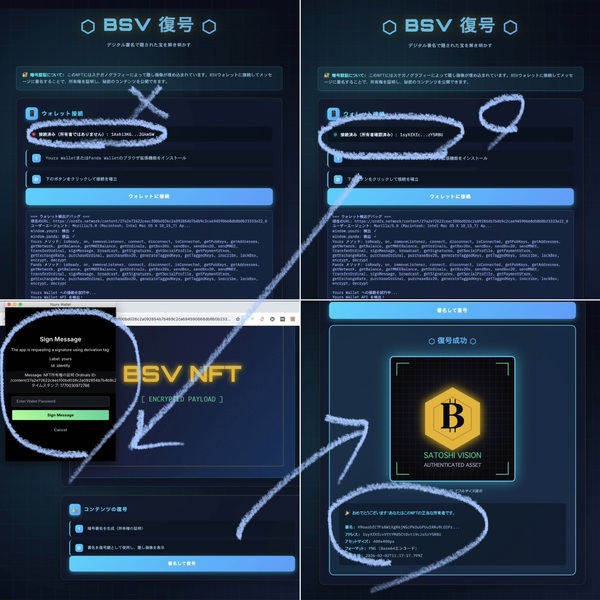
Based on what you said, I created my own prototype using the steps below.
I was able to successfully display the steganography by authorizing it using the YourWallet PC extension. However, this is just a test version that can be authorized from any wallet.
I'm currently struggling with modifying the system so that it can only be decrypted with a owned address.
However, as you say, too many steps are stressful for the user and detract from the artistic quality. I see, there is a way to utilize metadata... Still, if 3D Ordi makes it possible to create and view private ordinals, I'm very excited!
https://app.treechat.com/p/e6e622a6-ae14-4f46-bc78-0edf68df9d1d
!quoted by KURO
@J1 Pelaez
It worked!
When I connected this steganography Ordinals with a “not owner address”, it was rejected, but when I connected with an “owner address”, it was approved, decrypted, and the hidden image was displayed.
I don't think this is optimal, but as a creator, it's one of the possible methods I can think of at the moment.
Please let me know your thoughts.
Congratulations @KURO, you're still in the NFT creators lead!