Conversation isn’t linear. It’s a tree. You launch into an …
Conversation isn’t linear. It’s a tree.
You launch into an idea, branch into questions, detour into tangents, then "come back up the stack" and continue. That’s how humans think.
Replies
If you zoom out, a conversation is a hierarchical data structure:
nodes = messages / claims / decisions
edges = “this was a reply to that” / “this follows from that”
branches = tangents, alternatives, parallel workstreams
Most chat apps force the conversation tree into a line.
They take a naturally-branched structure and flatten it into a single dimension. The result: context collapse, repeated questions, “wait what are we talking about,” and lost decisions.
@spolsky has a great frame for this.
In his Trello post he argues
“The great horizontal killer application are actually just fancy data structures” https://www.joelonsoftware.com/2012/01/06/how-trello-is-different/
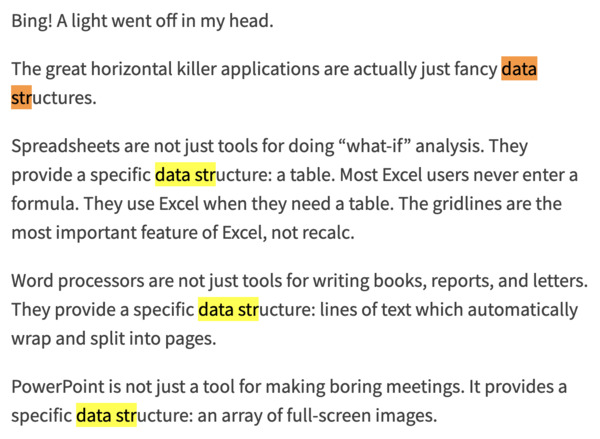
This is the key idea:
The best products don't win because they add features, but because they give you a better way to see and manipulate the underlying structure of your work.
TreeChat applies that to conversation.
TreeChat treats the “conversation tree” as the native object:
every reply is a potential branch, a full fledged living thread, not a footnote
tangents don’t derail the main line
you can effortlessly move between multiple threads without losing the plot
The structure is indespensible for async communication.
Async isn’t just “messages, but slower.”
Async means:
people respond at different times
multiple topics are active simultaneously
context has to be recoverable without live back-and-forth
Chat trees handle this naturally.
In a tree, you can do “parallel async” without chaos:
one branch = decision A
another branch = research thread
another branch = implementation details
another branch = edge cases / risks
No literally mixed messages. No pasting context into a new message every time.
Everything becomes findable and reusable.
When structure is explicit:
the “why” lives near the decision
the evidence lives near the claim
the alternatives live as siblings, not lost in the scroll.
Conversations suddenly become assets. The chat is the knowledge base.
Instead of “we talked about this somewhere,” you get:
reusable branches
linkable subthreads
a map of how you got to the answer
TreeChat was conceived and built for humans communicating asynchronously
…but the same structure is perfect for human to agent, and agent to agent communication.
Agentic work is also a tree:
decompose goal → subgoals → tasks
explore branches (options)
keep provenance (why we chose this)
merge results back into the main plan
The future is multi-agent orchestration in the same substrate:
Humans + agents collaborating in a shared branching workspace, where:
agents can take a branch and run
humans can inspect/redirect
results land back in-context, not as random blobs
TL;DR:
If chat is a never-ending single dimensional scroll, you get amnesia.
If chat is a tree that models and navigates the conversationdata structure—you get clarity, parallelism, and compounding knowledge.
This is Treechat.
https://x.com/metamitya/status/2027919880025186359?s=20