■ How to consume water and salt, the foundation of a health…
■ How to consume water and salt, the foundation of a healthy body?
- Our body is composed of bones, flesh, and blood, which is extracellular fluid, and operates as a series of living systems that consume minerals, which are essential elements for decomposing organic substances that provide calories, and perform physiological metabolism through appropriate aqueous solutions. Therefore, the question of how to eat is not only about organic substances, but also about consuming minerals for the proper concentration of cells and extracellular fluid, blood.
Therefore, the importance of water and salt is very important for health management.
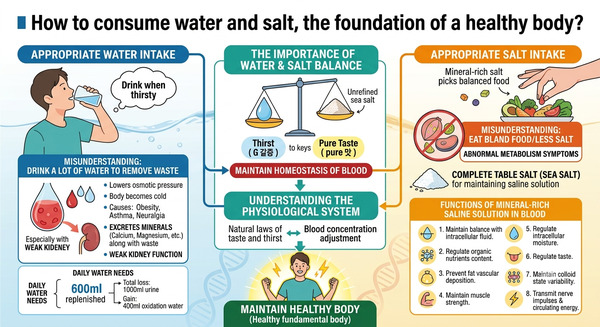
Usually, a healthy body drinks water when it feels thirsty. Therefore, drinking a lot of water for health even when you are not thirsty can be seen as an unconventional eating habit. Among the incorrect health information we come across, if someone tells us to 'drink a lot of water to remove waste products', we should take a closer look at this. The logic that drinking a lot of water that is suitable for drinking removes waste products in the body is an oversimplification of our physiological system. It is clear that water is excreted through urine or sweat when you drink it. However, is water directly excreted through sweat glands or urinary tract?
When you drink water, it is first transferred to the blood, and the excess water dilutes the saltiness of the blood. Blood is an extracellular fluid that maintains the osmotic pressure with the intracellular fluid that makes up 100 trillion cells and maintains the homeostasis of the blood. However, the saltiness of the diluted blood lowers the osmotic pressure, which also lowers the saline solution of the intracellular fluid.
If this happens, the body becomes cold, which can cause obesity, asthma, and neuralgia.
In addition, when excessive water intake discharges a certain amount of water from the body, the minerals that were components of the body fluid, such as calcium, phosphorus, magnesium, sodium, chlorine, potassium, sulfur, and trace elements, are discharged along with the waste products in the body. This is even more likely to happen for people with weak kidney function. And if these large minerals are lost, it can cause problems in the energy metabolism system, so it may take a lot of time and effort to restore the original state. So what is the appropriate amount of water intake?
A normal person urinates about 6-7 times a day, and the amount excreted through the urine is 1000ml.Considering that the amount of oxidation water obtained from the body's metabolism by consuming solid foods is 400ml, it is reasonable to assume that about 600ml can be replenished.
Of course, sufficient water supply is necessary in the summer when the temperature is high or when sweating occurs after exercise and physical desire appears as thirst. However, drinking a lot of water without thirst is considered unsound for this reason.
In the same logic, I have recently heard many people around me tell me to eat less salt and eat bland food, but this is also unsound.
For people with severe hypertension, it is reasonable to eat a low-salt diet during the treatment process. However, for ordinary people, eating bland food will also cause abnormal symptoms in the body's metabolism.
Since the blood serum components of our body fluids and extracellular fluids are composed of various minerals and can maintain osmotic pressure, a healthy physiological system is maintained and restored in the taste buds that are appropriately flavored with complete table salt such as sea salt.
In other words, our pure taste is ultimately a reaction to maintain the concentration of blood appropriately. When the blood components are maintained with sufficient food, the amount of food is naturally adjusted, and when necessary, we feel thirsty and drink water to maintain the homeostasis of the blood's saltiness.
This is because the so-called body fluid (saline solution) does not mean only sodium chloride (NACL), but rather refers to electrolytes composed of various minerals. According to the introduction of the functions of saline water in the blood of the human body in the academic world, first, maintaining balance with intracellular fluid,
second, regulating the content of organic nutrients in the blood, third, preventing fat from vascular deposition, fourth, maintaining muscle strength, fifth, regulating intracellular moisture, sixth, regulating taste, seventh, maintaining the variability of the colloid state of the protoplasm, and lastly, transmitting nerve impulses and circulating energy, table salt containing sufficient minerals is essential for our body.
As such, if we understand the importance of water and salt for health management and use them well, it is beneficial to our body, but if we misunderstand and misuse them, it is harmful to our body.
The physiological system of the human body was created according to the laws of nature, and when we maintain t…