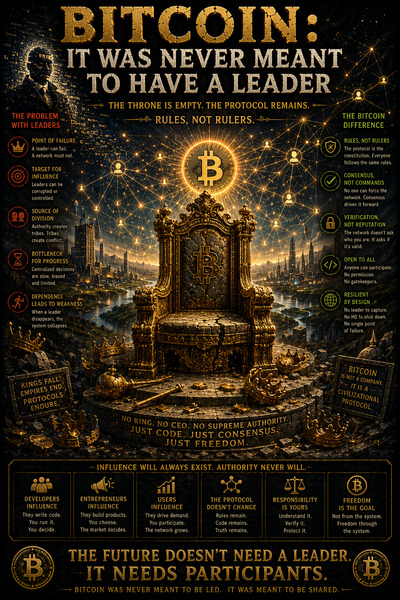
BITCOIN: IT WAS NEVER MEANT TO HAVE A LEADER Humanity has a…
BITCOIN: IT WAS NEVER MEANT TO HAVE A LEADER
Humanity has a habit.
Whenever something becomes important...
We look for someone to follow.
A king.
A president.
A CEO.
A prophet.
A visionary.
A leader.
It feels natural.
Comfortable.
Familiar.
But Bitcoin introduced a radical idea:
What if the system doesn't need one?
The Ancient Blueprint
For thousands of years, civilizations were organized around individuals.
Power flowed from the top.
The ruler made decisions.
The people followed.
The structure was simple.
One center.
Many followers.
This model shaped kingdoms, governments, corporations, and institutions.
It became the default architecture of human organization.
The Problem With Leaders
Leaders solve problems.
But they create new ones.
Every leader becomes:
A point of failure
A target for influence
A source of division
A bottleneck for progress
The stronger the leader...
The more dependent the system becomes.
Eventually the system begins serving the leader rather than the mission.
The Satoshi Disappearance
Most founders seek control.
Recognition.
Authority.
Influence.
Satoshi Nakamoto did something different.
He left.
No throne.
No successor.
No royal bloodline.
No official hierarchy.
The creator disappeared.
The protocol remained.
That decision may have been the most important design choice of all.
The Cult of Personalities
Humans struggle with leaderless systems.
So they constantly attempt to create new leaders:
Developers.
Influencers.
Entrepreneurs.
Executives.
Public personalities.
Every cycle produces new figures that communities rally around.
The desire for authority never fully disappears.
Bitcoin's Radical Design
Bitcoin was engineered around rules.
Not rulers.
Consensus.
Not commands.
Verification.
Not reputation.
Mathematics.
Not personality.
The protocol does not ask:
Who are you?
It asks:
Is the transaction valid?
That distinction changes everything.
The BSV Perspective
Bitcoin SV emphasizes stable protocol rules and scalable infrastructure.
The system functions regardless of:
Individual influence
Political popularity
Corporate authority
Social status
The network's purpose is not to empower leaders.
It is to empower participation.
Why Leaderless Systems Matter
Leaderless systems are difficult.
Messy.
Slow.
Sometimes frustrating.
But they possess something centralized systems rarely achieve:
Resilience.
If a leader disappears...
The network survives.
If an institution fails...
The protocol continues.
If authority collapses...
Verification remains.
The Difference Between Influence and Authority
People will always have influence.
Developers influence direction.
Businesses influence adoption.
Users influence demand.
But influence is not leadership.
No individual owns the network.
No individual commands consensus.
No individual speaks for everyone.
The Return of the Network
The internet changed communication.
Bitcoin may change organization.
The future may belong increasingly to systems where:
Rules matter more than rulers
Participation matters more than permission
Verification matters more than authority
This is a fundamentally different model of coordination.
The Human Instinct
The challenge is psychological.
People want certainty.
And leaders provide certainty.
Or at least the illusion of it.
But decentralized systems require responsibility.
Each participant becomes accountable for understanding the system themselves.
No king.
No priesthood.
No supreme authority.
The Protocol Civilization
Perhaps the deepest innovation of Bitcoin was never technical.
It was organizational.
The idea that millions of strangers can coordinate globally...
Without requiring a central leader.
Without requiring blind trust.
Without requiring a throne.
The protocol becomes the constitution.
The network becomes the institution.
Final Thought
History remembers kings.
Empires.
Generals.
Founders.
Presidents.
But Bitcoin introduced a strange possibility:
A system important enough to change the world...
Without needing anyone to lead it.
No emperor.
No chairman.
No supreme authority.
Just rules.
Consensus.
Verification.
And a network that continues operating whether anyone is watching or not.
Because perhaps the most revolutionary idea in Bitcoin was never money.
It was proving that order can emerge...
Without a ruler. 🚀
🔥 Make Your offer to own this article cover NFT 👇
Replies
!quoted by NFT_ProjectBSV