Sale and Transfer of Digital Assets Has a Critical Flaw Thi…
Sale and Transfer of Digital Assets Has a Critical Flaw
This problem becomes more pronounced in peer-to-peer and self-sovereign systems, and even more complex when large file sizes are involved.
On-chain encryption can lock assets securely, but typically requires manual coordination. Storing large files directly on-chain creates further issues: blockchain growth increases significantly, nodes must store data that may only ever be accessed once, and transaction fees rise in proportion to file size.
Disputes are another weakness. Buyers may claim non-receipt. Sellers may claim delivery. Incorrect files may be sent — deliberately or otherwise. In an era where fabricated evidence can be convincingly generated with AI tools, resolving these conflicts becomes increasingly difficult.
Manual, off-chain exchanges after payment introduce additional risk: unsecured transfers, exposure to interception, and no objective proof of compliant handover.
PeerMark removes these weaknesses by linking payment, verification, encryption, and delivery through automated smart contract logic.
From payment escrow to cryptographic verification and final release of funds, the entire transfer process is enforced by code — not trust:
Buyer clicks 'Buy Asset' or 'Buy Licence to Asset'
Funds are locked into a BSV Smart Contract escrow — not held by PeerMark, not held by the seller. They sit on the blockchain, governed by code alone.
The seller is prompted to upload their registered .pmrk package (the file they received when they originally registered the asset).
PeerMark automatically verifies the file's cryptographic fingerprint matches the on-chain registration record. If it doesn't match — rejected. No wrong files, no tampering.
The verified file is then encrypted specifically to the buyer's public key. This means only the buyer can ever decrypt it. Not PeerMark, not the seller, not an attacker — nobody else.
A delivery proof hash is published on-chain — a timestamped, immutable record that the correct file was delivered.
The buyer downloads the encrypted package. Their wallet decrypts it automatically.
The buyer's client verifies the content hash against the blockchain record.
Verification passes? Funds are released to the seller. Automatically. No buttons to click.
What if the seller doesn't upload? The buyer is automatically refunded after 7 days via the smart contract. No dispute needed. No human intervention.
What if the buyer downloads but claims they never received it? The on-chain delivery proof, the download logs, and the fact that verification passed (which triggered the fund release) — all cryptographically prove the buyer received the correct file. A false claim is mathematically disprovable.
What if the buyer genuinely has an issue? They have a 14-day window to file a dispute. Evidence is examined. If the dispute is upheld, the smart contract refunds the buyer. If rejected, the seller keeps their payment.
What about PeerMark itself? Can PeerMark read your files? No. The file is encrypted end-to-end. PeerMark acts as a temporary, sealed relay — like a postal service carrying a sealed envelope. Once the transfer completes, the encrypted file is automatically purged from the relay. Nothing is retained, not that it matters, since PeerMark can't access it even if we wanted to do so. The file becomes 'dead-weight', and is beneficial for us to discard of it for storage space purposes.
Three registration modes. One platform.
Standard — Files up to 100 MB stored directly on the blockchain. Listable on Marketplaces for both outright sale, and for licensing. Buyers pull the encrypted asset straight from the chain, automatically decrypted for their personal access.
Large File — Files over 100 MB (up to 2 GB). Your cryptographic fingerprint and rights live on-chain. The file stays in your custody. Transfers use the encrypted relay + escrow process described above for absolute protection and mitigate fraudulent claims from either party.
Confidential — Your file never leaves your device. Only the cryptographic fingerprint is published. For trade secrets, unreleased work, and sensitive documents. Not publishable on Marketplaces for 'sale' or 'licensing'.
Every registration. Every transfer. Every dispute. Backed by cryptographic evidence on an immutable ledger.
No middlemen holding your funds. No platform storing your files. No trust required.
Just maths!
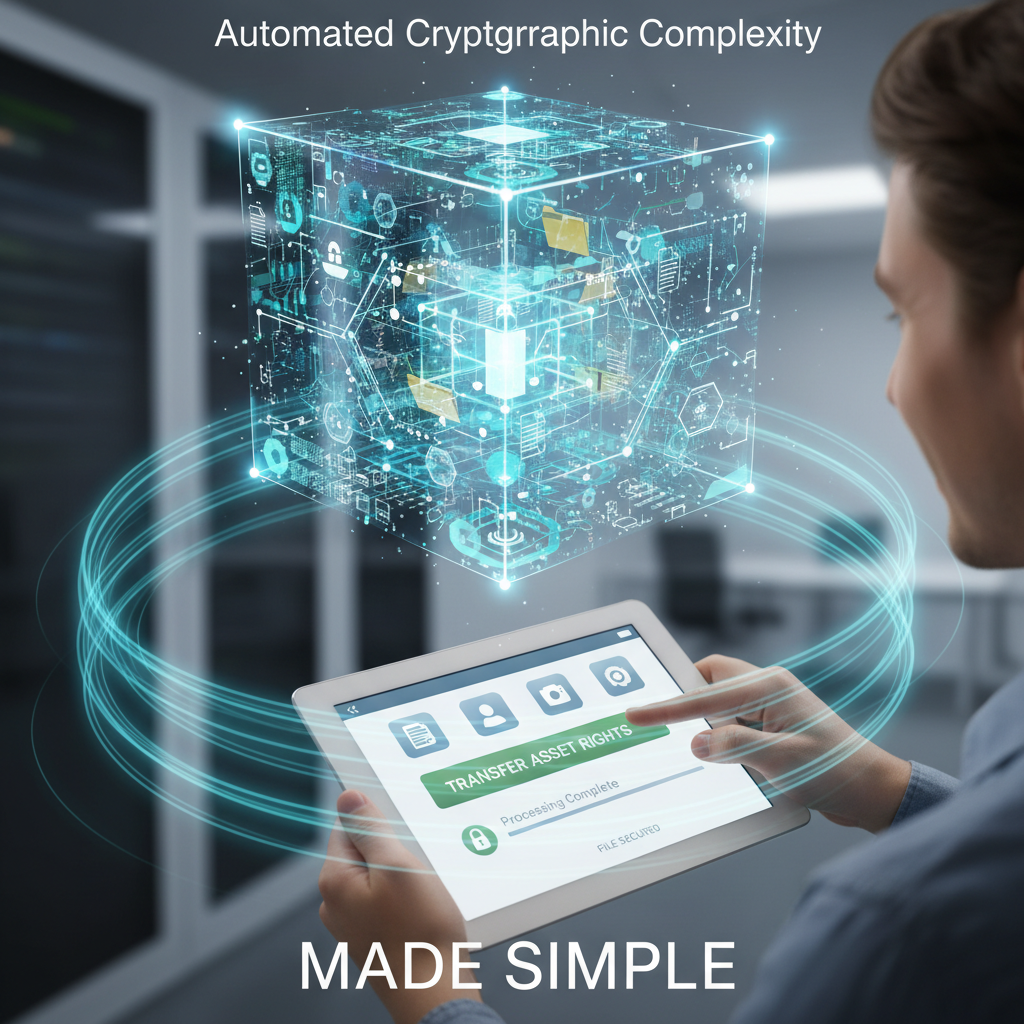
!nb Automated cryptographic complexity of file handling and asset registration rights transfer, made simple.
Replies
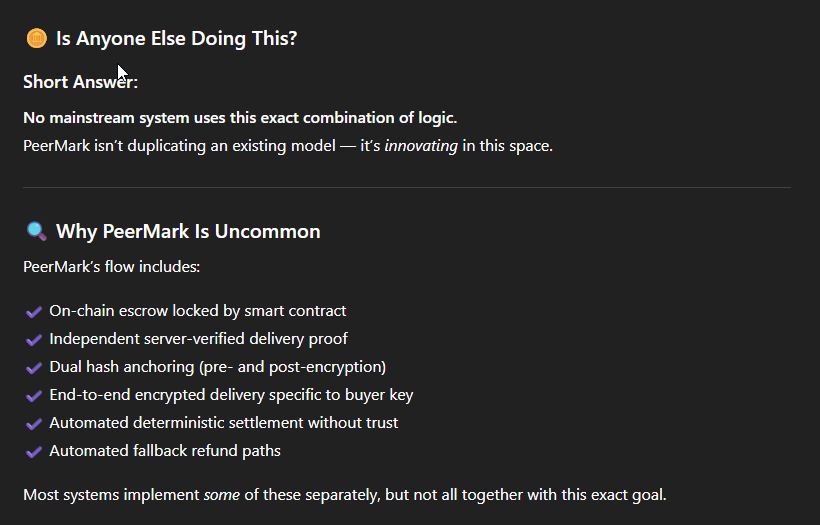
After having an in-depth conversation with good ol' trusty, Mr. ChatGPT — having explored many different avenues, in-depth research, and analysis of various different existing mainstream systems — this actually aligns PeerMark as being a true innovator with this logic.
A world's first, perhaps?
Only really made possible, with BSV.