BSV: WHEN ISLAM LED GLOBAL FINANCE Before Wall Street… Befo…
BSV: WHEN ISLAM LED GLOBAL FINANCE
Before Wall Street…
Before the Federal Reserve…
Before the IMF…
The world once ran on a financial system built on moral law.
And that system came from Islamic civilization.
For nearly 800 years, global trade routes, banking principles, and financial ethics were shaped by a framework that rejected exploitation and prioritized justice in commerce.
Today, as the modern financial system trembles under debt, inflation, and uncertainty, a powerful historical question returns:
What happened when Islam led global finance—and what lessons does it hold for the future of money?
The Golden Age of Islamic Finance
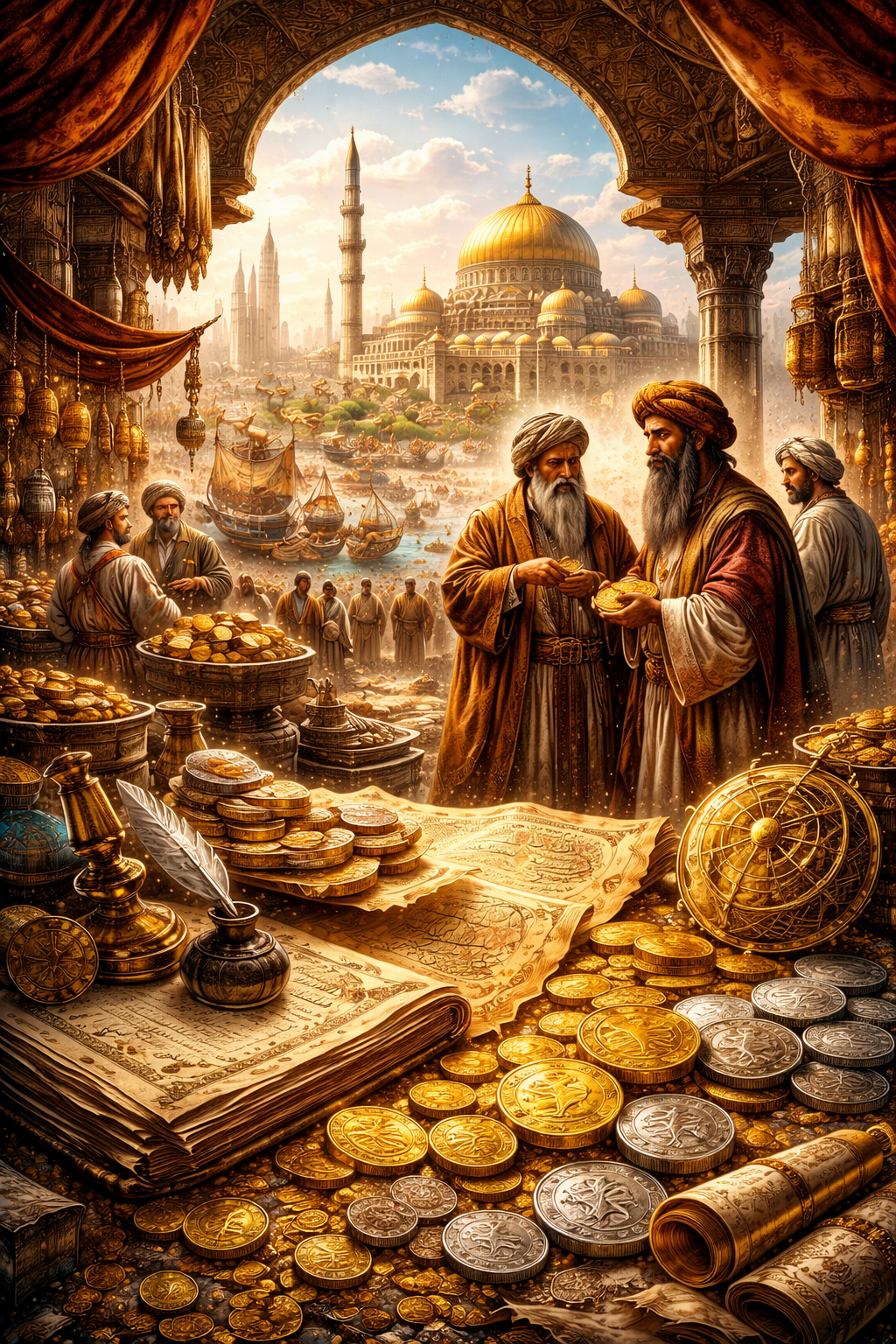
Between the 8th and 15th centuries, the Islamic world controlled the most advanced trade and financial networks on Earth.
From Baghdad to Cordoba, from Cairo to Samarkand, merchants operated across continents using financial instruments centuries ahead of their time.
The Islamic economic system introduced innovations such as:
Bills of exchange (Sakk) — the origin of the word cheque
Partnership contracts (Mudarabah) — early venture capital
Trust-based trade networks across Asia, Africa, and Europe
Stable gold and silver currencies (Dinar and Dirham)
At a time when much of Europe operated in fragmented feudal economies, the Islamic world had already created global financial infrastructure.
The Moral Foundation of Money
What made Islamic finance different was not just the instruments.
It was the ethical framework behind them.
Islamic financial law was built on several core principles:
No Riba (usury)
Interest-based debt was prohibited because it concentrated wealth without productive economic activity.
Risk sharing
Investment required partnership, meaning both profit and loss were shared.
Real economic backing
Financial activity had to be tied to tangible assets or real trade.
Justice in transactions
Contracts had to be transparent and mutually beneficial.
This framework created a financial system designed not merely for profit—but for social stability.
The Power of Honest Money
Central to this system were gold and silver coins.
The Gold Dinar and Silver Dirham circulated across vast territories, maintaining stable value for centuries.
These currencies were trusted because they possessed:
Intrinsic value
Universal acceptance
Resistance to political manipulation
Unlike modern fiat systems, rulers could not easily inflate them.
The supply of money was constrained by nature itself.
The Collapse of the Old System
Eventually, the Islamic financial system lost its global dominance.
Several factors contributed:
The rise of European maritime empires
Colonial control of trade routes
The shift toward interest-based banking systems
The emergence of centralized national currencies
By the modern era, global finance had moved away from asset-backed money toward debt-driven fiat systems.
This transformation reshaped the world economy—but it also introduced vulnerabilities.
The Crisis of Modern Finance
Today’s financial system operates on massive layers of debt.
Global debt now exceeds $300 trillion.
Central banks manage economies through:
Interest rate manipulation
Monetary expansion
Currency devaluation
While these tools can stabilize crises temporarily, they also create structural instability over time.
This is why discussions around ethical finance, sound money, and decentralized systems are gaining renewed attention.
Digital Infrastructure and the Future of Finance
The rise of blockchain technology has reopened a question humanity once solved centuries ago:
How should money function in a just and stable economy?
Bitcoin introduced the idea of a neutral monetary protocol governed by rules rather than institutions.
Within the Bitcoin ecosystem, different visions exist regarding how this system should evolve.
Bitcoin SV emphasizes scalability and utility, focusing on creating infrastructure capable of supporting large-scale economic activity through:
Massive transaction throughput
Low transaction costs
On-chain data and payments
Stable protocol rules
In theory, such infrastructure could support new financial systems that combine technological efficiency with ethical economic principles.
A Historical Echo
The story of Islamic finance is not just history.
It is a reminder.
A reminder that financial systems reflect the values of the societies that build them.
When money is tied to fairness, transparency, and productive economic activity, economies can flourish.
When money becomes detached from real value and dominated by speculation, instability grows.
Final Thought
The future of global finance is still being written.
Technology is transforming the way value moves across the planet.
But the deeper question remains timeless:
What kind of financial system should humanity build?
One based purely on profit…
Or one grounded in justice, transparency, and stability.
History shows that civilizations which balance economic innovation with ethical foundations often create the most resilient system…
Replies
!nb Tales from One Thousand and One Nights! 🤨
!nb My wonderful donkey world is beautiful enough for me. I don't need that barbaric time of murder and slavery back! Thanks, but no thanks! ⛔️

1.23 BSV