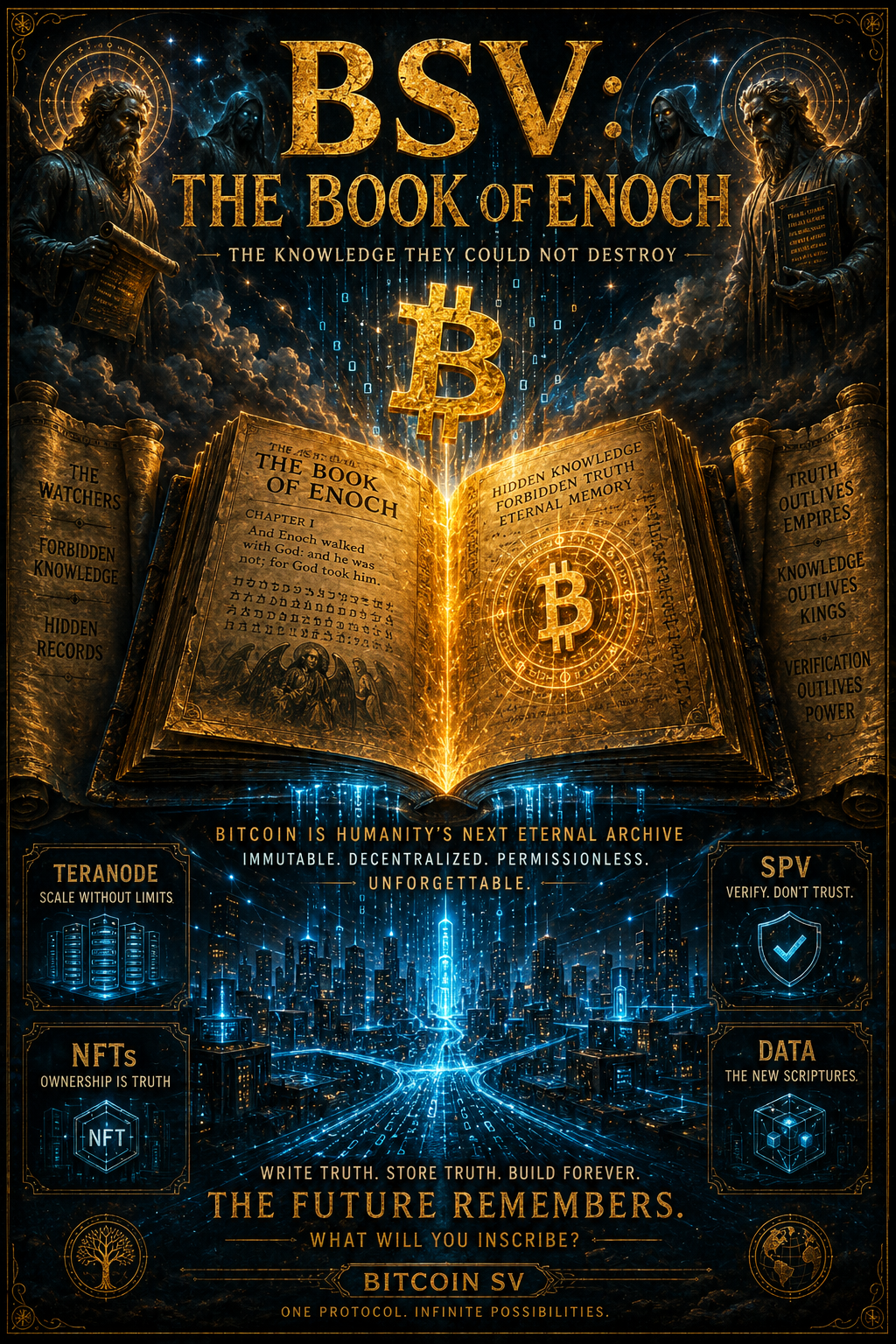
BSV: THE BOOK OF ENOCH The Knowledge They Could Not Destroy…
BSV: THE BOOK OF ENOCH
The Knowledge They Could Not Destroy
Opening Hook
What if humanity has been here before?
Not Bitcoin.
Not computers.
Not blockchains.
But knowledge.
Dangerous knowledge.
The kind of knowledge that changes civilizations.
The kind of knowledge that threatens empires.
The kind of knowledge that powerful institutions would rather control than share.
Thousands of years ago, an ancient text emerged from the shadows.
A mysterious manuscript known as the Book of Enoch.
A book so controversial it was removed from most religious canons.
A book filled with forbidden knowledge, fallen watchers, hidden wisdom, and warnings about the future.
For centuries it survived.
Not because it was protected.
Because it could not be erased.
And perhaps that is the most important lesson for Bitcoin SV.
Because every age creates its own Book of Enoch.
Every age creates knowledge that refuses to die.
Chapter One: The Lost Book
History is not merely a collection of events.
It is a collection of surviving information.
Most civilizations disappear.
Most libraries burn.
Most records vanish.
Most knowledge dies.
The winners write history.
The losers become myths.
Yet occasionally a document escapes destruction.
The Book of Enoch was one of those documents.
Hidden.
Forgotten.
Rediscovered.
Surviving centuries of suppression.
The book became a symbol of an uncomfortable truth:
Knowledge has a strange tendency to outlive those who attempt to bury it.
Chapter Two: Information Is Power
Every empire understands the same principle.
Control information.
Control society.
Ancient kings controlled scribes.
Religious institutions controlled manuscripts.
Governments controlled archives.
Corporations controlled databases.
The mechanism changes.
The objective remains identical.
Control the record.
Because whoever controls the record often controls reality.
The challenge has always been the same:
How do you preserve truth when institutions can rewrite history?
For thousands of years, humanity lacked an answer.
Then Bitcoin arrived.
Chapter Three: The New Book of Enoch
Most people think Bitcoin is money.
What if Bitcoin is something far more dangerous?
A permanent memory system.
An immutable record.
A ledger that refuses to forget.
For the first time in human history, information can be stored in a system beyond the direct control of any single institution.
Transactions.
Ownership.
Records.
Documents.
Proof.
History itself.
Suddenly the economics of truth begin to change.
The Book of Enoch survived because copies existed.
Bitcoin survives because verification exists.
One relied on preservation.
The other relies on mathematics.
Chapter Four: The Watchers
In the ancient text, mysterious beings known as Watchers descend and share forbidden knowledge with humanity.
Whether literal or symbolic is irrelevant.
The deeper lesson remains.
Knowledge transforms civilizations.
Fire transformed civilizations.
Writing transformed civilizations.
Printing transformed civilizations.
The internet transformed civilizations.
Bitcoin may transform civilization by changing humanity's relationship with truth itself.
Not through force.
Not through politics.
But through verifiable records.
Chapter Five: The Teranode Scrolls
Every great civilization eventually faces a scale problem.
The Roman Empire.
The British Empire.
The Internet.
Bitcoin faces the same challenge.
A permanent global record is meaningless if it cannot support global activity.
This is where scalability becomes essential.
Teranode represents a future where Bitcoin can evolve beyond a niche financial system into planetary infrastructure.
Millions of transactions.
Massive data systems.
Global economic activity.
Suddenly the ledger becomes more than a ledger.
It becomes a civilization archive.
A modern Book of Enoch written not on parchment...
But on a scalable blockchain.
Chapter Six: SPV and The Witnesses
Ancient history relied on witnesses.
Modern society relies on institutions.
Bitcoin introduces a third option.
Verification.
SPV allows participants to verify information without trusting intermediaries.
This may appear technical.
It is actually philosophical.
Trust moves from authority to proof.
From reputation to verification.
From belief to mathematics.
The implications are profound.
Civilizations built on proof behave differently than civilizations built solely on trust.
Chapter Seven: The NFT Scriptures
What if future historians do not study paper archives?
What if they study NFTs?
Property records.
Identity systems.
Educational achievements.
Art.
Scientific discoveries.
Business agreements.
Each preserved as verifiable digital artifacts.
The NFT evolves beyond collectibles.
It becomes memory.
A civilization that can permanently remember becomes fundamentally different from one that constantly forgets.
Conclusion: The Final Chapter
The Book of Enoch survived because truth is difficult to kill.
Bitcoin survives for the same reason.
Ideas are resilient.
Knowledge is resilient.
Trut…