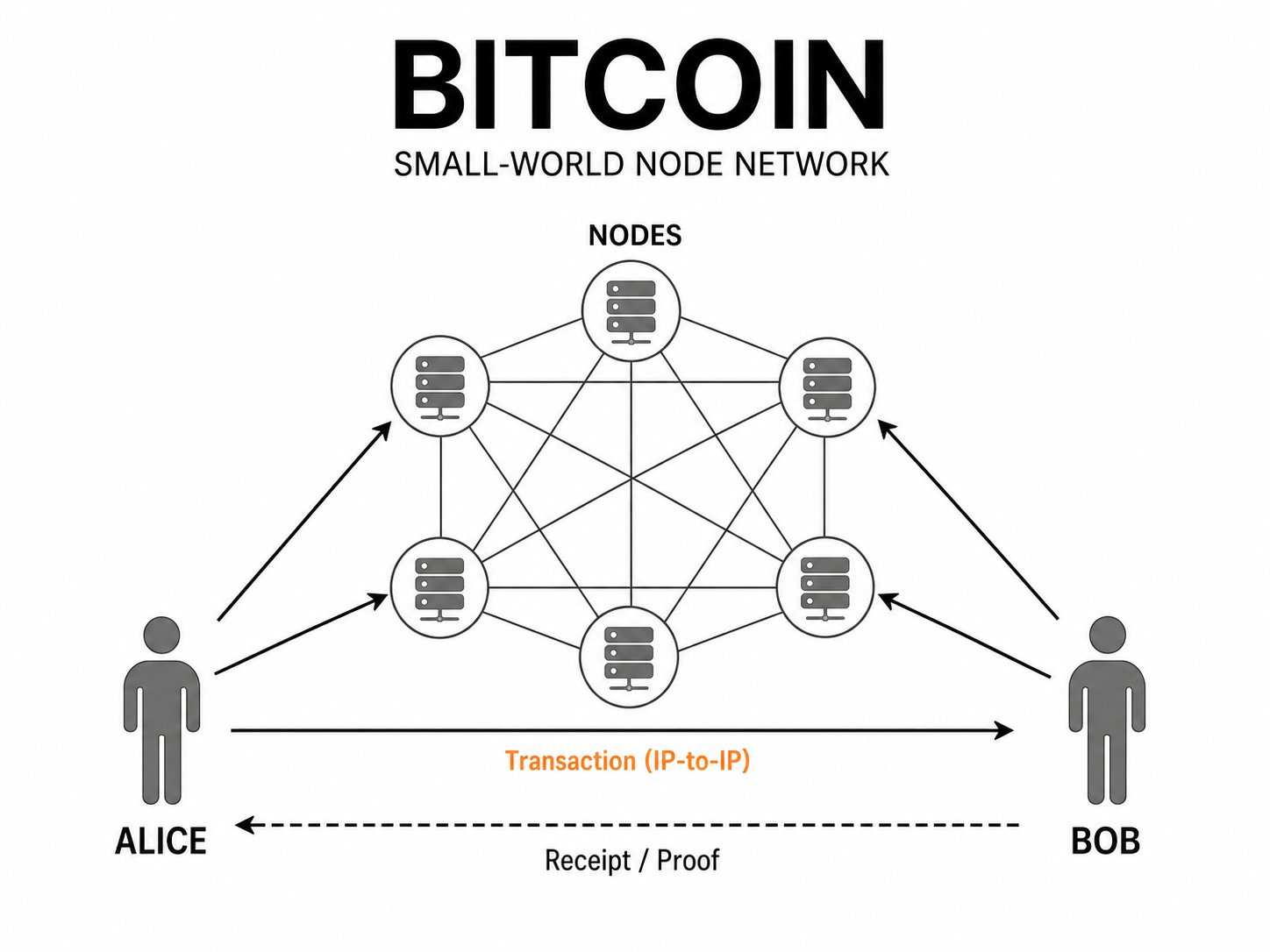
This is how Bitcoin is really designed. Alice sends to Bob.…
This is how Bitcoin is really designed.
Alice sends to Bob. Alice also sends to nodes. Bob sends to nodes. Bob returns a separate proof — a receipt — showing that he has sent. The nodes are not decorative little saints sitting in a chapel of theory; they are densely interconnected economic actors, passing information through a web so robust that failure becomes not a drama but an edge case.
Notice what is not being said.
Alice is not a node.
Bob is not a node.
A spectator with software is not a node merely because he enjoys the costume.
The nodes are the competitive parties that build, validate, propagate, and settle. Alice and Bob are peers. That is peer-to-peer: not a mystical commune of hobbyists, but a direct exchange between parties, with the network serving as the machinery of settlement.
The elegance is that trust is not required. Trust is the tax paid by badly designed systems. In Bitcoin, Alice does not need to trust Bob to behave nobly. Bob does not need to trust Alice to remain honest. The system is constructed so that proof, propagation, economic interest, and record replace sentiment.
And if someone reneges, the parties with an actual interest in the transaction still act. They propagate. They evidence. They settle. They do not need sermons on virtue, because incentives have already done what sermons pretend to do.
That is the architecture: direct exchange, proof returned, nodes interconnected, incentives aligned, failure reduced, trust displaced by evidence.
Bitcoin was not designed as a theatre for slogans.
It was designed to work.
Written by S. Tominaga