PeerMark is not a generic: "Upload your text or file, call …
PeerMark is not a generic: "Upload your text or file, call it yours — give me a bit of commission to a treasury/change wallet and fuck off!" App.
PeerMark is extremely complex. Not complex by means of UX, but by means of a well thought-out architecture. Packaged files, automatic processing of never seen before logic to improve your asset registrations and tie that to a legal entity, or party if necessary. It's complex, because it has to be. It's destined to be future-proofed. It's designed to be the reliable layer should any issues arise. It's the platform which automatically checks if your files hash already exists on the Network, so a dispute can be raised.
Your files are encrypted by a unique hash. That hash is used to grant access to the asset in the event you transfer/license the asset. You don't need to go looking for your files by manually scanning the blockchain, or the entirety of the internet to see if someone has 'fraudulently' tried to claim, copy or clone your asset. Firstly, it's designed so that is very difficult to do so. It's designed so that your file is not accessible by anybody but you, unless you chose to share it. "Confidential" options allow your files to strictly never be shared with anybody but yourself.
This is privacy. This is true self-sovereign control. Truly reliable evidence trails when you need it most. Automatic alerts when potential disputes are found/located.
Usually, doing such things this way is not inherently difficult to achieve for someone with capable skillsets, however — doing all of this whilst maintaining an absolute requirement of self-sovereignty is what makes things more difficult. It's complex error-handling, especially since these things have never been explored before. It's hundreds, if not thousands of hours of testing, repeatably. It's the art of exploring almost every single possible avenue to make things extremely difficult for anyone to copy your creations, your assets.
Traditional apps don't stop that.
There is nothing stopping somebody from simply fraudulently claiming ownership rights/registration rights to any one of your creations, your assets, your intellectual property. If they get there first, they have 'first refusal rights' since they "appeared" to be the first to register it, are they the rightful owner? No.
This is where the complexity comes in, this requires serious in-depth logic. Not just machine-checks, not just 'oversight boards' or 'attestations' and 'legal compliance', but a vast array of MANY, MANY things working hand-in-hand, not only to protect your assets once registered — but to protect them well, irrefutably.
---
!nb Seriously hardened asset registration protection logic. Futuristic, modern, and alert.

Replies
Your assets are bundled into a custom '.pmrk' folder type. This is not to be altered, and is merely a physical copy of your proof which is saved to your local machine. This can be backed up onto physical other devices, or stored elsewhere. The package file can be uploaded which will then be analysed in the browser to run checks against the system and on-chain records to ensure it matches, along with checksum verifications to ensure no files were altered, even accidentally. Small changes are noted to the user, in the event that the user perhaps does this accidentally. PeerMark is STILL able to detect if the contents of the file are accurate to the original, and provides a 'score' on how far from the original file it deviates if altered.
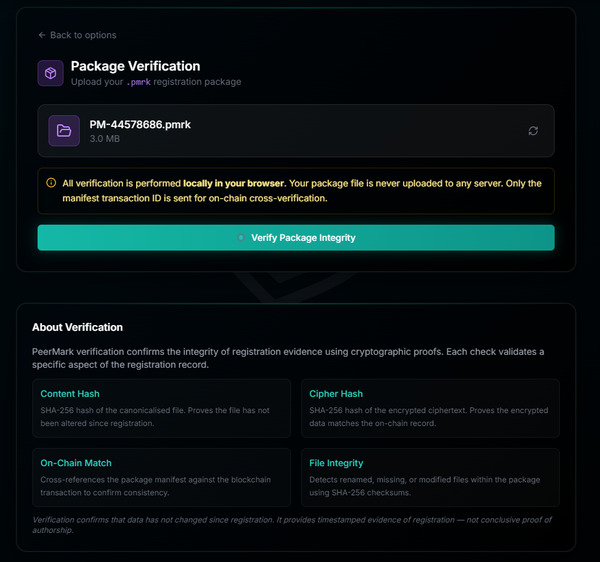
Contents of the folder (which can be opened in any 'ZIP' style viewer/software) are as attached. All of this data is examined in-depth via our verification system, to alert for any mis-match within the package folder which is not 'true-to-life' and flagged as potentially false/fraudulent.
THIS is how asset registrations should be handled. Truly hardened, verifiable logic, complex checks — which would often take hours to verify manually, completed automatically.
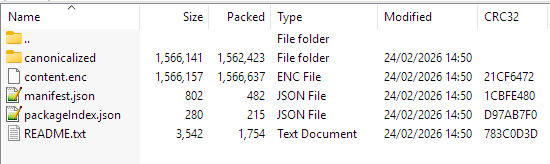
(Purposely altered) to show a flag on the on-chain cross-reference verification.
This isn't simulation, it truly works!
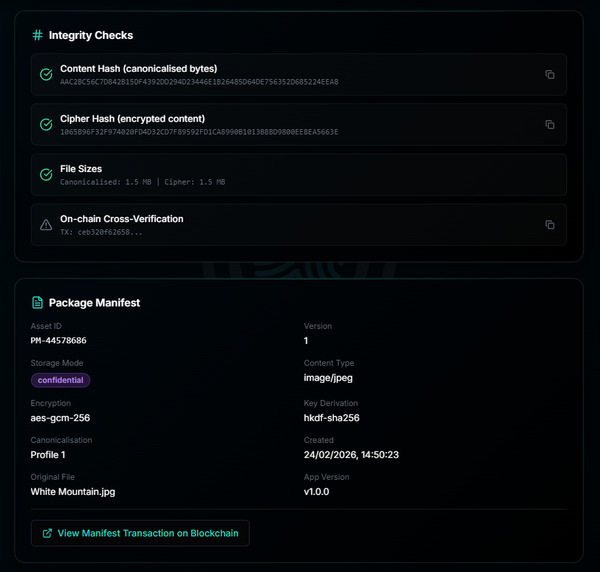
"Content.enc" is an encrypted file, containing the real important stuff. This is only decrypted by means of a 2-of-3 logic via your PeerMark account.
- Threshold: 2-of-3, no single party can spend.
- Device share: WebAuthn/Passkey (secure enclave/WebCrypto).
- Account recovery share: user-encrypted blob tied to account credentials; unusable by server alone.
- User-held recovery share: hardware/printed secret.
In the event that someone gains access to your account, or manages to get hold of the .PMRK package folder, this is an additional layer to prevent asset theft/transfer to the attacking party.
Last but not least, we also issue a PDF Certificate.
This can be used for a variety of purposes (and is less complex than dealing with the PMRK package file, which is intended to be used in the event of any disputes or serious legal repercussions, etc).
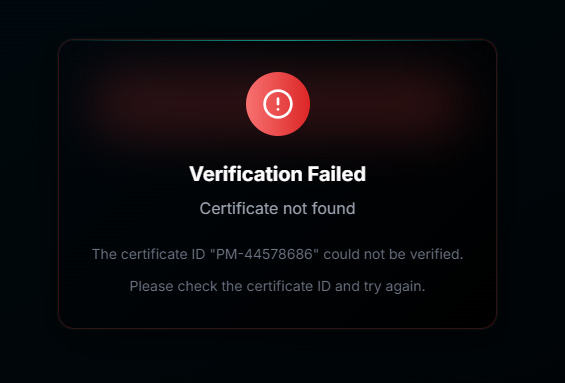
These can be verified separately, and are used for means of Licensing/Sales of the Assets — Of course, for the package above — which failed the Blockchain TX Verification Checks, the certificate is also invalid for this PM Asset ID.
Many different verification routes may seem complex at first, but they are absolutely necessary to lead the way in terms of legal compliance not only for asset registration claims, but tokenisation of both Digital and Real-world Assets in general.