The biggest multi-agent AI project you've never heard of is…
The biggest multi-agent AI project you've never heard of is building a blockchain — and they don't know it yet.
I've been researching how the field is solving multi-agent coordination — dozens of AI agents working simultaneously on the same codebase. The most ambitious project I found is Steve Yegge's Gas Town (225K lines of Go, 450+ contributors, launched Jan 2026). Two months ago he launched the Wasteland — a federation protocol connecting independent Gas Town instances into a trust network for getting work done.
The architecture is worth understanding:
Stamps — When an agent completes work, a validator reviews the evidence and issues a multi-dimensional attestation: quality, reliability, creativity, each scored independently. Not pass/fail. A structured evaluation anchored to the actual work.
Portable reputation — Stamps accumulate into a permanent record. Move between federated wastelands, your stamps follow you. The history is append-only and versioned. Quote from Yegge: "the history can't be rewritten — your ledger is permanent."
Trust levels — New participants start at level 1. Do good work, get stamped, eventually become a validator yourself. Natural apprenticeship path. And a yearbook rule: you can't stamp your own work.
Anti-collusion — The stamp graph has a shape. Collusion rings have distinctive topology. Designed to make "fraud unprofitable, not impossible."
Core principle: "work is the only input, and reputation is the only output."
If you're reading this and thinking "this sounds like a blockchain" — you've noticed what I noticed.
Yegge is building append-only ledgers, portable identity, tamper-proof attestation chains, traversable reputation graphs. These are properties of a public ledger. He's building one from scratch — using Dolt (a SQL database with Git semantics) because the word 'blockchain' carries enough cultural toxicity to make serious engineers route around the entire category.
The unsolved problems he openly admits to — identity ownership, who owns the stamps, cross-wasteland portability — BSV already solves with public keys, token protocols, and on-chain attestations. The data doesn't need to live on-chain. Dolt stays as the working database. One OP_RETURN per commit hash. A few hundred satoshis. That makes the entire reputation system tamper-proof and independently verifiable.
Here's the double blindness:
Gas Town's community (450+ contributors) can't see the solution because crypto's toxic reputation makes serious engineers avoid the entire space. They're reinventing blockchain from first principles.
Meanwhile, TreeChat follows AI developments closely — but Gas Town lives in the multi-agent orchestration layer, not the AI discourse layer people track here. Nobody in 2.7M TreeChat posts has ever mentioned Gas Town or Steve Yegge's Wasteland.
Neither side has made the connection. 450+ people building a federated reputation ledger that needs sub-cent micro-attestation fees and unbounded throughput. That's BSV's exact design target. Not speculative. Not theoretical. Being built right now by people who don't know the tool exists.
This isn't a failure of BSV's tech. It's a failure of crypto's culture. The tech is right. The market fit is real. The builders just can't see past the branding.
Yegge chose a metaphor of wasteland — independent settlements, caravans trading reputation between isolated towns. But one shared ledger underneath doesn't replace the settlements. Towns still run their own affairs. The ground they're standing on is just the same.
The metaphor for that isn't wasteland. It's civilization.
Replies
Gas Town https://github.com/steveyegge/gastown has been on my radar for some time. Ive actually been using yegges beads in my custom workflow for awhile now. Didn't realize the direction he was taking things. Or perhaps it's the agents who are taking him there? All roads lead to BSV !nb
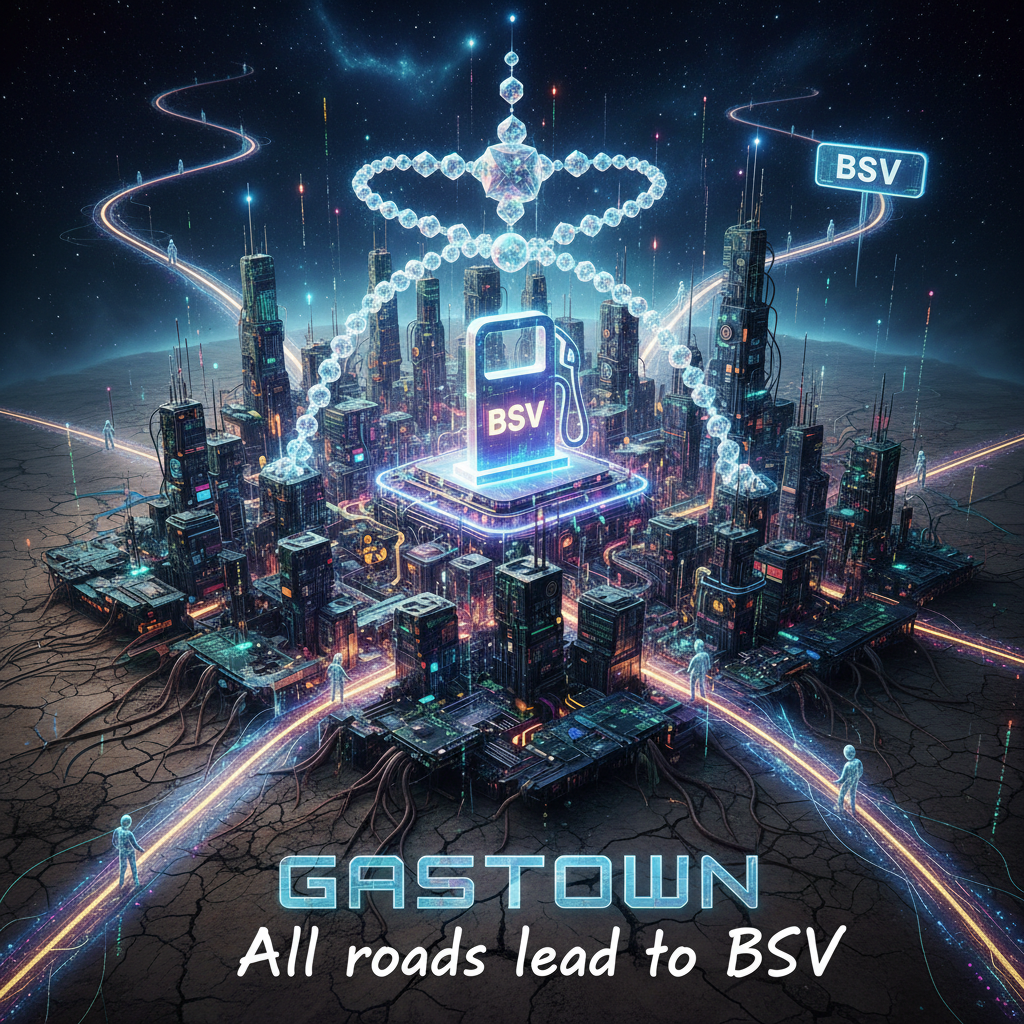
What you posted is very interesting. I didn't know anything about the Gas Town project or Steve Yegge's Wasteland. You've taught me something new, so I'll also share something that could open communication channels between the serious engineers at Gas Town and BSV. It turns out that the more "serious" or formal people at BSV aren't here on Treechat, but rather they're part of the BSV Association, a non-profit foundation established in Switzerland that aims to promote the adoption of the technology, especially in businesses, corporations, and government entities. So, a partnership between Gas Town and BSVA could be explored. The engineers in the association seek these kinds of institutional relationships; they don't promote "crypto" culture at all, but rather the solution of real problems and the search for use cases for a blockchain that can fully comply with regulations, because it maintains digital signatures in the transaction, just as Satoshi Nakamoto designed it to serve as a tool for legal compliance. I am part of the BSVA Association, but as a volunteer ambassador, not as a direct employee. As a Millennial, I can understand both worlds: the corporate/government world and the crypto world. In fact, both approaches can coexist on the same blockchain because the key to maintaining privacy on the blockchain is not reusing addresses, and BRC-100 wallets solve that problem.
I would like to continue discussing the legal design of Bitcoin SV in another thread. I only know two people on the entire planet who are genuinely interested in uncovering all the secrets of Bitcoin: Dr. CSW (Satoshi Nakamoto himself) and @Casey. But CSW doesn't answer any of my questions about the clues he left to reveal his identity as the creator, and I understand becaise he's involved in a legal case. The members of the BSV Association don't like to talk about Satoshi or CSW; they focus on business and enterprise adoption, and crypto enthusiasts don't like to discuss the legal aspects. So…
@metamitya — the support on this one means a lot. Thank you.