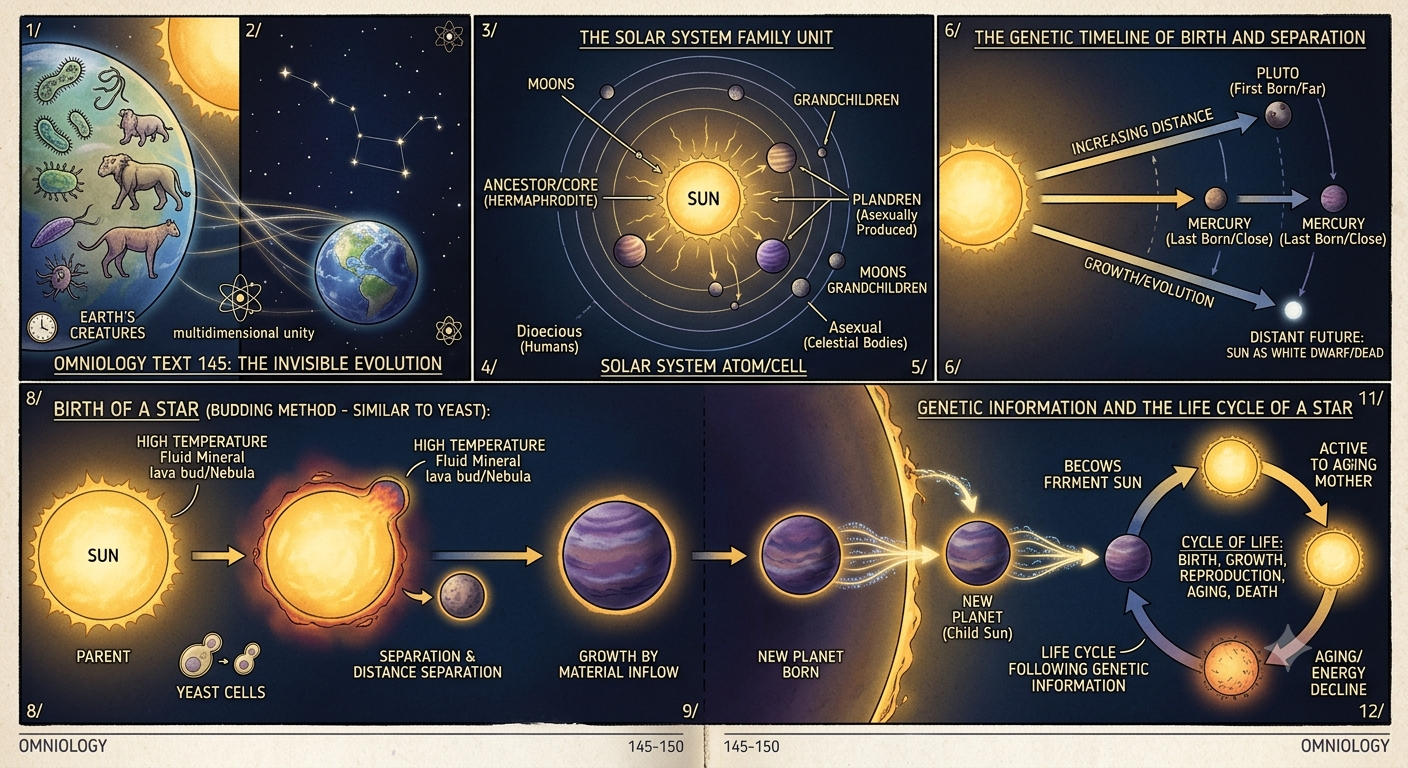
9. Evolution of celestial bodies (omniology text p145~150) …
9. Evolution of celestial bodies (omniology text p145~150)
ㅡ We have learned that these creatures are evolving from microorganisms to higher organisms by observing the evolutionary phenomenon of the Earth's biota. However, the evolution of these creatures on Earth is a cross-section of the evolutionary phenomenon of the Earth itself, and therefore, we can infer that all beings in the universe are evolving together through the concept of multidimensional unity.
Therefore, it is self-evident that all celestial bodies scattered throughout space are evolving, but when we see that they always have the same constellations and star shapes, the evolution of celestial bodies cannot be realistically accepted from the perspective of ordinary humans. Of course, celestial bodies exist in a different dimension from ours, and the time and space dimensions of life activities are also completely different, but in any case, we cannot clearly feel any evolutionary progress with our five senses.
Therefore, in order to examine the evolution of these celestial bodies, we have no choice but to examine the traces and progress of evolution in a dimension within the solar system where observation is easier, and use that principle to infer the evolutionary phenomenon of other stars.
1) Family of the Solar System
In the previous cosmological theory, the smallest unit of life that can survive on its own was explained as a star. The solar system is a family unit where three generations, including our Earth, live together.
Therefore, the sun is the best ancestor and core being of our solar system family, while other stars are children and the moon (satellite) is grandchildren. Likewise, the solar system is a group of celestial bodies, but when viewed from far away in space, the only being that emits light is the sun, and other celestial bodies revolve around it in a very close state, so there is only one sun in the shape of an atom or cell. This is the same structure as a human family where three generations live together. The difference here is that humans are dioecious, so there are two core beings: a grandfather and a grandmother, but in the case of the sun, there is only one sun because it is a hermaphrodite.
This should be clearly understood. Many people mistakenly believe that all beings in the universe are hermaphrodites because humans and most animals are hermaphrodites. However, most plants and all celestial bodies, except for humans and animals on Earth, are hermaphrodites, and produce offspring through asexual reproduction, where one being can spread offspring without the union of two parents.
So, if we examine the solar system in detail with this knowledge, all the planets in the solar system, namely Mercury, Venus, Earth, Mars, Jupiter, Saturn, Uranus, Neptune, and Pluto, are ultimately children of the sun. And their birth years were not all born at the same time, but were born with a large time difference. The planet that is farther from the sun is the star that was born first, and the planet that is closer is the star that was born later. And the satellites that orbit around the planets are ultimately the planets’ children, and the farther away the satellite is, the earlier it is born.
And the distance between stars was not as far as it is now since they were first born. As stars grow and evolve, the distance between them gradually increases. Currently, all stars in the solar system maintain their vitality through the energy supply from the sun, but in the distant future, all planets will grow into stars, and by then, the sun will have emitted all its energy, grown old, and died.
2) Birth of stars
As explained above, the phenomenon of birth, growth, reproduction, aging, and death, which are unique to living organisms, appear in the celestial world. Anyone who understands cosmic biology will accept this as an extremely universal and natural phenomenon. However, it is impossible for humans, who possess only five extremely limited sensory organs, to observe the lives of giant beings with a core radius of several thousand to tens of thousands of kilometers spread over a wide area of 1 billion kilometers.
(* Explanation: The galaxy to which our solar system belongs has a diameter of 100,000 light years. Its length is 9.46 trillion kilometers (1 light year) × 100,000, the distance light travels in a year.)
Therefore, we have no choice but to infer the reproductive phenomenon that occurs in the beings around us based on the universal common principle of multidimensional unity. If we observe the reproductive phenomenon of Earth creatures, we can see that there are extremely diverse reproductive methods, and they are broadly divided into asexual reproduction of hermaphrodites and sexual reproduction of hermaphrodites.
However, in the case of celestial bodies, as mentioned earlier, they have a physiology that cannot help but reproduce through asexual reproduction of hermaphrodites. From that perspective, if we lo…