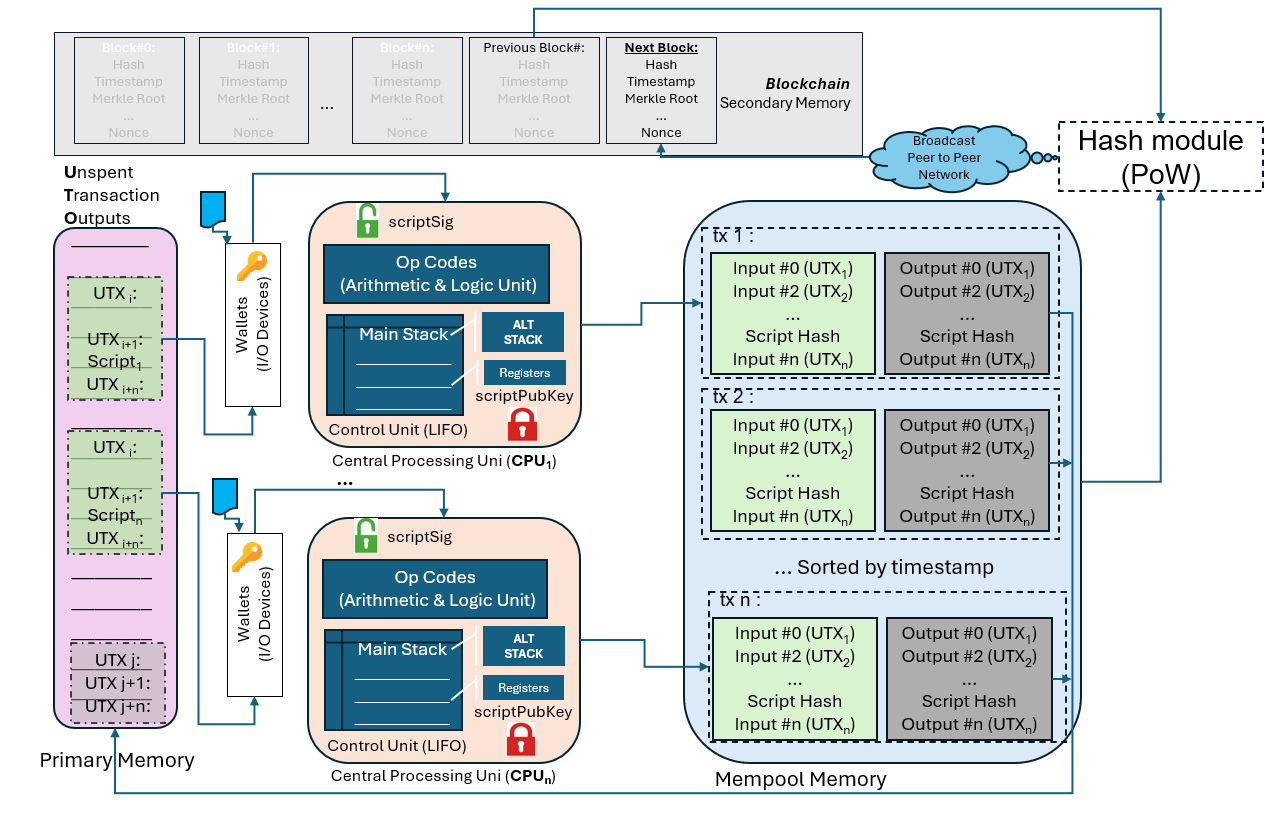
Bitcoin Computer Architecture.
Bitcoin Computer Architecture.
Replies
First draft of Bitcoin Computer Architecture, let me know your comments, what it need to be included or modified. What name would you like to this diagram.?
i think it would be helpful to make a video explaining the diagram, maybe talk through a simple tx and how it flows through this image
This is cool.
Bitcoin Computer Architecture description.
Introduction to the Concept
Bitcoin, introduced in 2008 by Satoshi Nakamoto, is primarily known as a decentralized digital currency that uses blockchain to record transactions. However, its technical design, based on distributed nodes, proof-of-work consensus, and a scripting language, has led some to compare it to a computational system. This comparison is not trivial, as it involves viewing the network as a set of components that collectively perform functions similar to those of a computer: processing data, storing information, and executing instructions.
Analogy Between Computer Architecture and Bitcoin
To understand this comparison, let’s consider how Bitcoin’s elements might correspond to the components of a basic computer architecture:
Memory → Blockchain: In a computer, Secundary memory stores data and instructions (Hard drive). In Bitcoin, the bloc(kchain acts as distributed memory, storing all historical transactions permanent . In a computer, the primary memory refers to the memory that the CPU can directly access (RAM), in Bitcoin the current state of unspent transaction outputs (UTXOs) works as primary memory, ensuring an accessible record for all nodes. And finally the Cahe memory in a computer is used to execute the instruction into the CPU, in Bitcoin that memory is the Stack used to store temporary the scrip registers during the execution. Both RAM and Cache are volatile.
Instructions → Bitcoin Scripts: Instructions in a computer are commands executed by the processor. In Bitcoin, scripts, written in a Forth-like language, define the conditions under which coins can be spent, acting as simple programs. This analogy is particularly evident in Bitcoin SV, that allows for more complex scripts.
Inputs → UTXOs (Unspent Transaction Outputs): Inputs in a computer are the data being processed. In Bitcoin, UTXOs are unspent outputs from previous transactions that serve as inputs for new transactions, akin to …
[[learn bitcoin]]
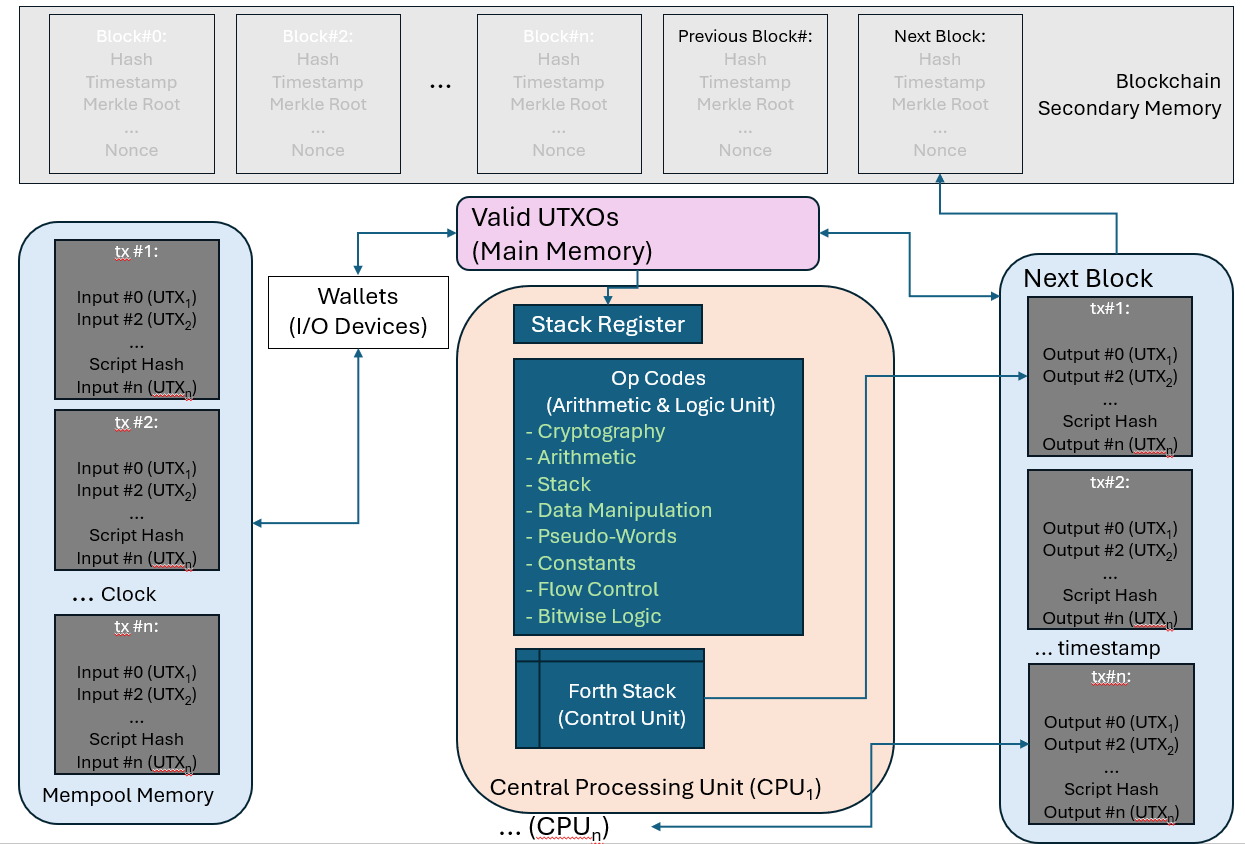
Improved Bitcoin Computer Architecture: