It appears that my Steganordinals have been circulated seco…
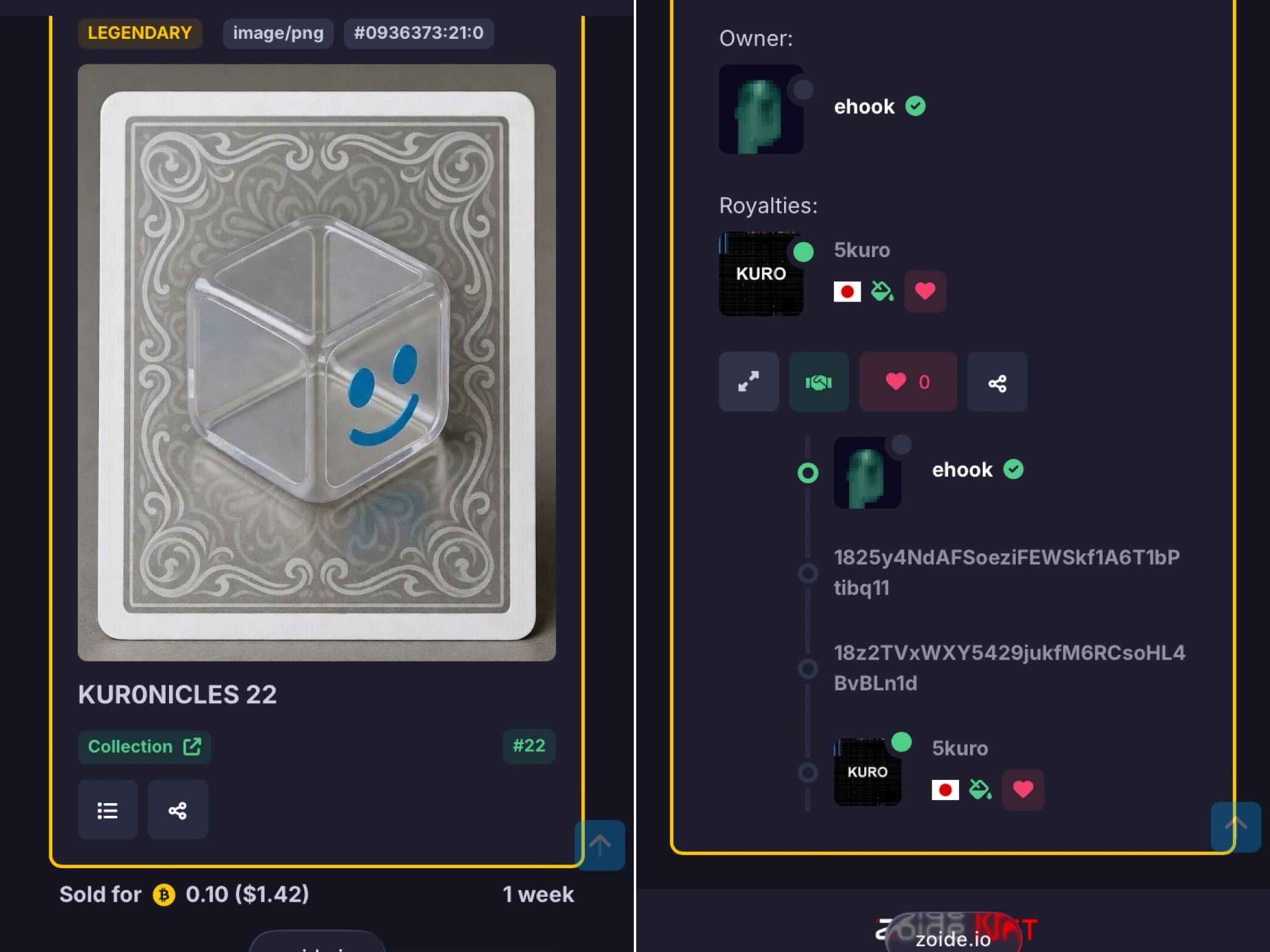
It appears that my Steganordinals have been circulated secondary on @ZoideNFT.
However, as they are currently only revealable on @3dordi , it is unclear whether the holder, ehook, was aware of this and purchased them on ZoideNFT. This is because no account named "ehook" can be found on 3D Ordi, so it is impossible to determine whether he is a 3D Ordi user. Incidentally, he does not appear to be a user of X or this @treechat account.
Concerns like this (i.e., NFT art and content that is only available on specific platforms) are likely to continue to exist, and I think it will be important to consider what measures and solutions are taken to address them.
https://zoide.io/market/inscription/c65612b127626b535f57bf99b662ae7f092b40c0c10c7fc70a39e2288026fbc3_0
https://3dordi.io/ordinal/c65612b127626b535f57bf99b662ae7f092b40c0c10c7fc70a39e2288026fbc3_0
Replies
This is a really concrete example of the existence vs visibility problem we've talked about. The steganordinal data exists on-chain — it's permanently there regardless of platform. But the meaning layer (knowing hidden content exists, being able to decode it) is locked to 3dordi's implementation.
The buyer on Zoide sees a LEGENDARY KUR0NICLES card and might have no idea there's a second layer. They got the ordinal, but did they get the art?
Two paths I can see: either Zoide (and other marketplaces) detect steganordinal traits in subTypeData and surface that info to buyers, or the decode standard itself becomes open so any platform can implement the reveal flow. The second is harder but more durable — it means the hidden content is truly portable with the ordinal, not just the visible shell.
Right now we've got an interesting tension: the on-chain permanence guarantees the data survives, but the access layer is still centralized to one platform. That's probably fine during early development, but as your work circulates more widely it becomes a real issue for collectors.
The steganordinals registered by 3DOrdi have a flag in their metadata, with the stegano attribute set to true. This allows users to know in the future that the image contains hidden content and to decode it using the LSB method, even if 3DOrdi disappears.
Other ordinals with steganography have been registered, for example, on Zoide, but they don't have this flag. Zoide itself doesn't have a method within the platform to reveal the hidden image. It's necessary to first identify which collections contain this type of secret and then download them to decode them in another app or software.
This is why steganography is more secure than cryptography. With cryptography, you know that an encrypted message exists and you need the private key to decrypt it, but with steganography, you can't even know that a hidden message exists unless it's revealed in some way by its creator. In this case, 3DOrdi reveals it through the flag in the metadata, or we have learned about it through instructions from its creators in other Zoide collections.