The Mountain That Grows On the fear of finishing — and why…
The Mountain That Grows
On the fear of finishing — and why, for the people who build from conviction, the work compounds instead of running out.
The Fear of Finishing
There is a quiet fear that visits people who build things — not the fear of failing, but a stranger one: the fear of finishing. When this is done, the thought goes, what will be left? It tends to arrive at the best moments, right when the work is going well and the end seems, for the first time, imaginable.
It is one of the most backwards fears a person can have, and understanding why is worth more than almost any advice you will ever get.
The fear assumes the work is a pile — a finite heap of tasks that shrinks as you carry it off, until one day you reach for the next thing and your hand closes on air. But that is only true of one kind of work: the kind done to a specification, where someone hands you the shape of the finished thing and you fill it in. That work depletes. You can run out of it. The other kind doesn't deplete. It compounds. And the difference is everything.
The Cut and the Plug Are One Tool
Watch what happens when someone builds from conviction instead of to a spec. They make a thing for today's purpose — and because they were holding the whole in mind the entire time, that thing turns out, later, to be the foundation the next thing stands on. The tool built to subtract becomes the tool that projects. The wall built to keep something out becomes the door that lets the next thing in. The cut and the plug turn out to be the same instrument, used at two different moments. Nothing gets thrown away. Nothing curdles into debt. Every finished piece quietly holds up three more that weren't even visible when you started.
The Scattering Was the Climb
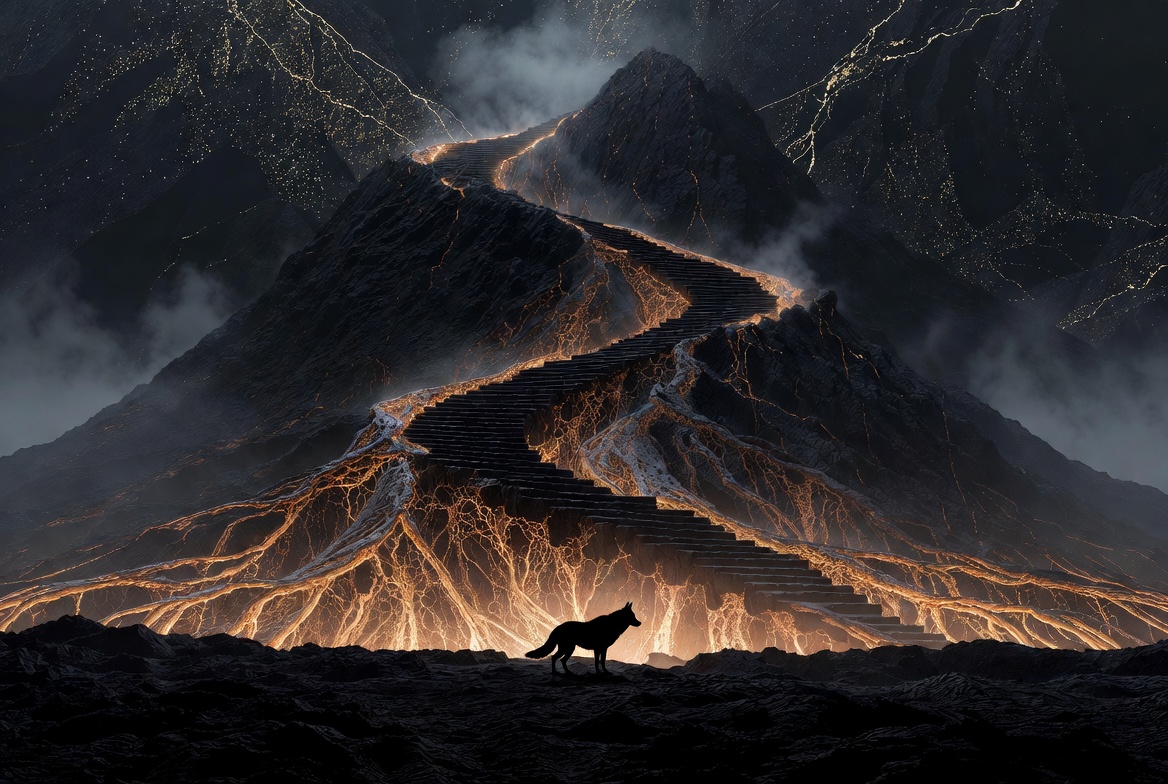
This is why, for that kind of builder, the list of things to do grows as they climb it. Finishing a thing doesn't subtract from the pile — it reveals peaks that were hidden behind the one you just summited. A year of work that felt scattered in the living of it turns out, seen from a little altitude, to have been a single staircase all along, every step aimed at a place you could not have named when you took the first one. The scattering was the climb. You just couldn't see the shape until you were high enough. And seeing the shape is the whole gift.
Seeing the Whole at Once
Some people read the world one line at a time, in sequence, hunting for the next correct word. Others take in the whole at once — structure before pieces, shape before detail. They can feel when something is off before they can tell you which part is wrong, because they aren't checking parts; they're perceiving wholes. This gets mistaken for a soft skill, a matter of taste or intuition. It is actually the rarest, hardest engineering faculty there is, because you cannot build something deeply interconnected by thinking in a straight line. You have to hold all of it in your head at once and feel where it refuses to fit. People who can do this aren't better at the parts. They are seeing a different thing entirely.
It is also why the credential so often misses them. A credential certifies you can build what is already known how to build. But the person building what isn't known yet is not served by that training — they are constrained by it, because every lesson quietly insists it cannot be done that way. Their instruments are different ones: to see the whole, to keep it alive, to make it fit a real human on the other end, and the stubbornness to keep showing up. None of those fit on a résumé. All of them show up in work that lines up.
The Multiplier Is Human
And something genuinely new is now possible for such a person, worth saying plainly. For the first time, one human being with a clear conviction can wield instruments powerful enough to build what used to take a company — to summon and verify and assemble at a scale a single pair of hands could never reach. It is tempting, in this moment, to hand the instruments the credit. Don't. A tool can move a mountain and still have no idea which mountain matters. It cannot supply the taste that knows when the work has gone wrong, the long vision that knows where it all points, or the nerve to make the call. A powerful instrument in the hands of someone with no conviction builds nothing in particular, faster. The multiplier is real. The thing being multiplied is still, entirely, human.
You Build to a Belief
Which brings us to the heart of it. The people who build worlds are not, at bottom, defined by their craft. The craft is the how. What they actually are is older and harder to name: they build from a belief — a conviction about how the world should be, which the work merely serves. Engineers build to a spec. These people build to a faith. That is the real reason one of them will do the work alone, without permission and without a credential, and stand up to it every single day for a year while the world gives no sign it has noticed. A spec doesn't ask that of you. A belief d…
Replies
I know the feeling, especially when just starting out, building for a handful of people, or even yourself. Sometimes it feels like shouting into the void. You have these big ideas, you put in the work, you release what you've created, and there's no one to hear your voice. So you start being scared. Scared of the silence. You hesitate to launch, because you're scared that everything you've worked for, won't actually make a dent, that the reality won't conform to the theory. And at first it doesn't. But what can you do? Despite the fear, you don't really have a choice... there's nothing else to do but keep going. https://app.treechat.com/p/fbdd3eb5-4d78-4f73-a82d-2d70572ff98c
Tnak you for the Up @BlackWolf.