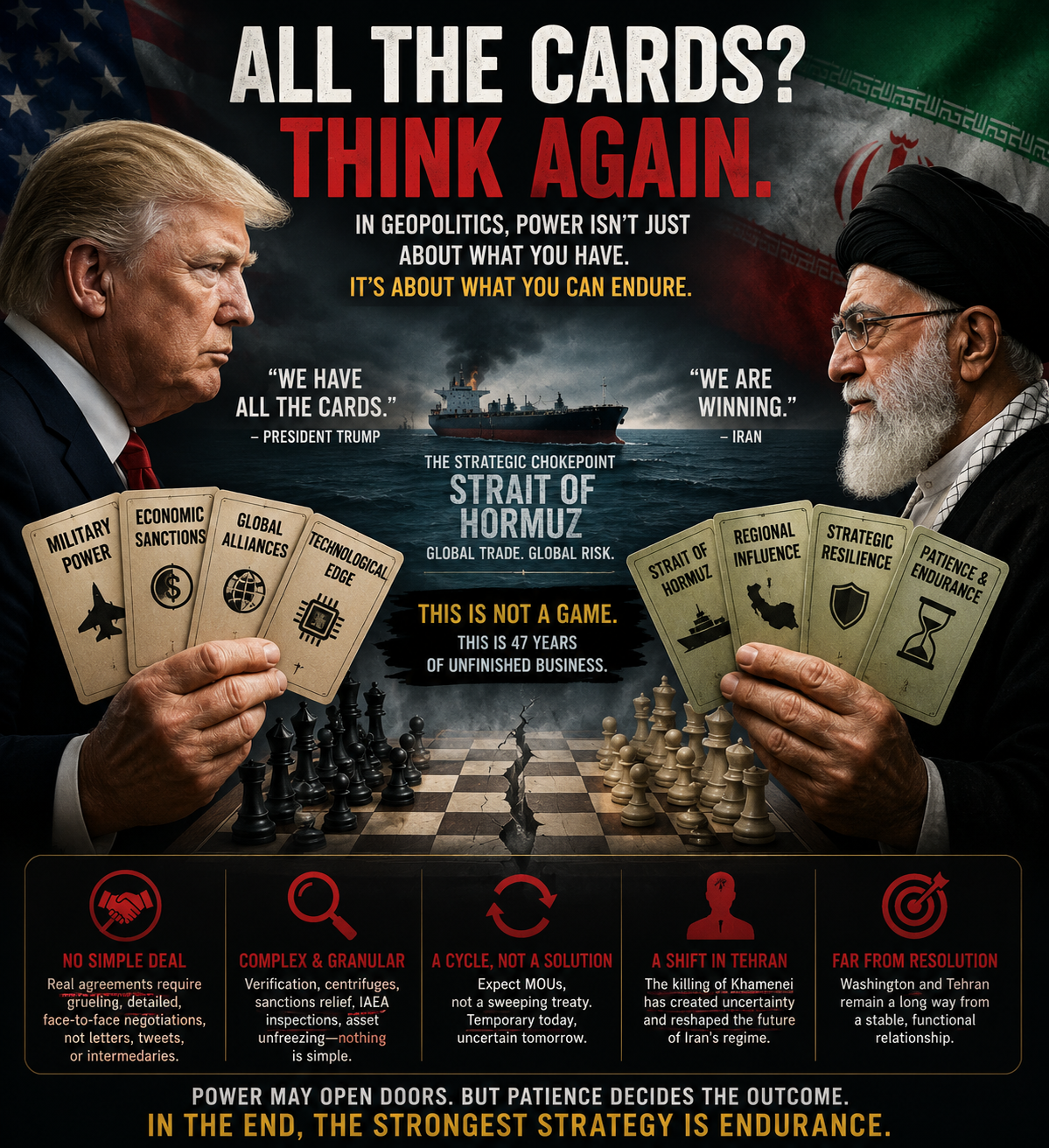
President Trump says America holds "all the cards." Iran be…
President Trump says America holds "all the cards."
Iran believes it is winning.
The truth is that when both sides claim victory before an agreement exists, diplomacy is usually still far from success.
For decades, the United States has possessed overwhelming military superiority over Iran. Yet after 47 years of sanctions, threats, negotiations, proxy conflicts, and diplomatic standoffs, neither side has achieved its ultimate objective.
This raises an uncomfortable question:
What if power in the 21st century is no longer measured by who has the strongest military, but by who can withstand pressure the longest?
Iran's greatest strength has never been its economy.
It has never been its military.
Its greatest strength has been its ability to absorb punishment while maintaining strategic leverage.
Meanwhile, Washington continues to discover that military dominance does not automatically translate into political outcomes.
The real challenge is that modern geopolitical conflicts rarely end with decisive victories.
They end with temporary arrangements, managed tensions, and carefully crafted narratives designed to convince domestic audiences that someone won.
This is why the future may not be a historic peace treaty.
It may be an endless cycle of temporary understandings, partial concessions, and strategic pauses.
In business, we call this risk management.
In geopolitics, we call it diplomacy.
The bigger lesson extends beyond Iran and America.
Nations, like companies, often overestimate the value of power and underestimate the value of patience.
History is filled with powerful actors who possessed all the resources.
But not all the resilience.
The most dangerous assumption in strategy is believing you hold all the cards while your opponent still believes they have a winning hand.
#Geopolitics #Leadership #Strategy #InternationalRelations #MiddleEast #RiskManagement #Diplomacy #PoliticalAnalysis #GlobalAffairs #LeadershipMatters