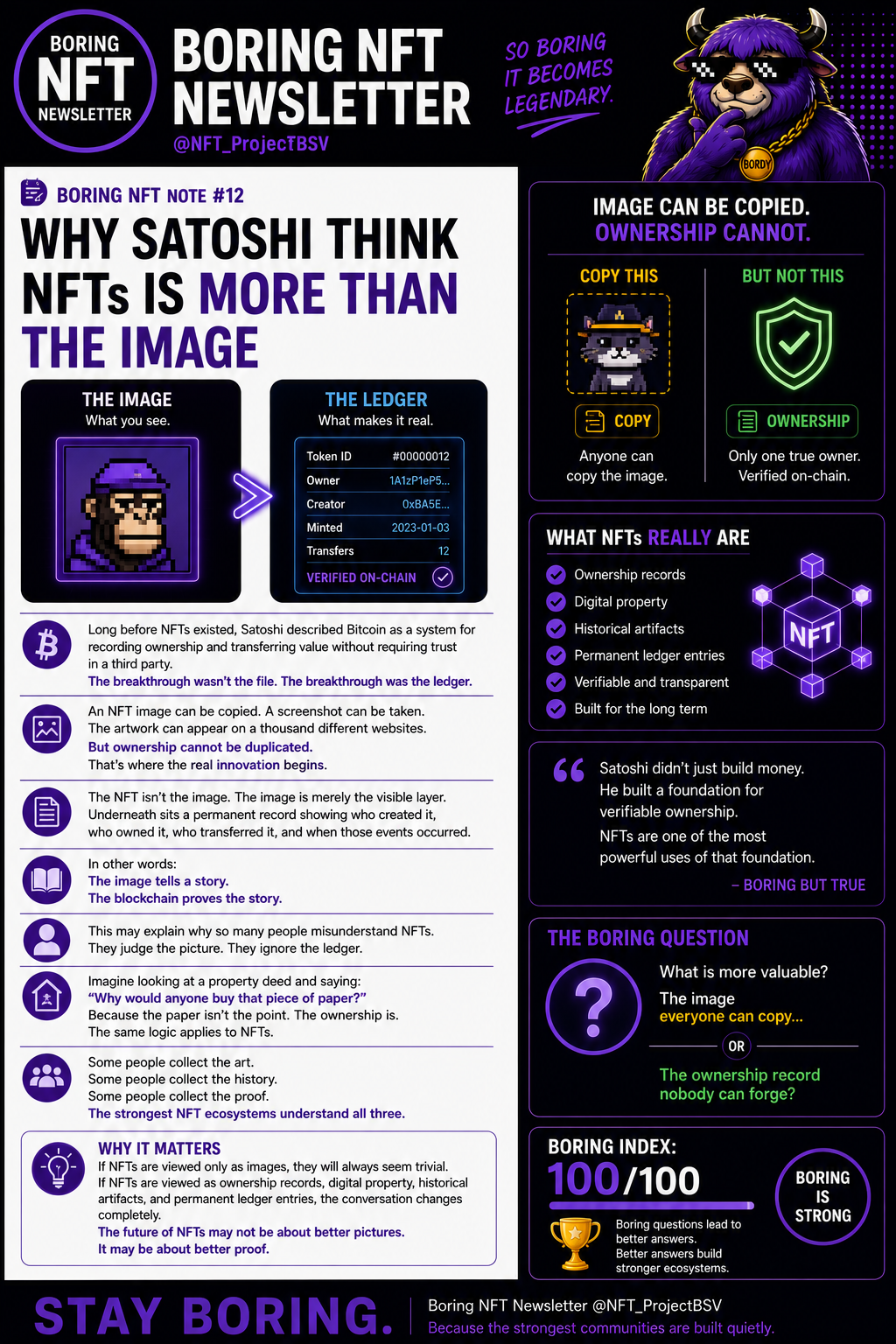
📝 BORING NFT NOTE #12 Why Satoshi Think NFTs Are More Than …
📝 BORING NFT NOTE #12
Why Satoshi Think NFTs Are More Than The Image
Most people see an NFT and immediately look at the picture.
Satoshi would probably look at the transaction.
That's an important difference.
The image is what attracts attention.
The ownership record is what makes it matter.
Long before NFTs existed, Satoshi described Bitcoin as a system for recording ownership and transferring value without requiring trust in a third party.
The breakthrough wasn't the file.
The breakthrough was the ledger.
An NFT image can be copied.
A screenshot can be taken.
The artwork can appear on a thousand different websites.
But ownership cannot be duplicated.
That's where the real innovation begins.
The NFT isn't the image.
The image is merely the visible layer.
Underneath sits a permanent record showing who created it, who owned it, who transferred it, and when those events occurred.
In other words:
The image tells a story.
The blockchain proves the story.
This may explain why so many people misunderstand NFTs.
They judge the picture.
They ignore the ledger.
Imagine looking at a property deed and saying:
"Why would anyone buy that piece of paper?"
Because the paper isn't the point.
The ownership is.
The same logic applies to NFTs.
Some people collect the art.
Some people collect the history.
Some people collect the proof.
The strongest NFT ecosystems understand all three.
Why It Matters
If NFTs are viewed only as images, they will always seem trivial.
If NFTs are viewed as ownership records, digital property, historical artifacts, and permanent ledger entries, the conversation changes completely.
The future of NFTs may not be about better pictures.
It may be about better proof.
🟣 Boring Index: 100/100
The Boring Question
❓ What is more valuable?
The image everyone can copy...
Or the ownership record nobody can forge?
Stay Boring.
🟣 Stay Boring.
Boring NFT Newsletter @NFT_ProjectBSV
Because the strongest communities are built quietly.