Claude would answer (server issues?) but grok sed this The …
Claude would answer (server issues?) but grok sed this The idiom "guinea pig" (meaning a person or thing used as a test subject in an experiment, trial, or new procedure) comes directly from the historical use of actual guinea pigs (the small, cute rodents, scientifically Cavia porcellus) in scientific and medical research.<grok:render card_id="09be3d" card_type="citation_card" type="render_inline_citation"><argument name="citation_id">17</argument></grok:render>
### Why the Animal Is Called a "Guinea Pig"
Guinea pigs are neither pigs nor from Guinea (in West Africa). They originated in the Andes region of South America, where indigenous peoples domesticated them thousands of years ago for food, pets, and even folk medicine. Spanish explorers brought them to Europe in the 1500s–1600s as exotic pets.<grok:render card_id="9d7027" card_type="citation_card" type="render_inline_citation"><argument name="citation_id">3</argument></grok:render>
The name's origins are murky, but leading theories include:
- "Guinea" part: They may have been shipped to Europe via Guinea (or Guinea-men ships involved in trade routes), leading to confusion about their origin. "Guinea" was also a vague English term for any distant/exotic land. Another idea links it to a corruption of "Guiana" (a South American region), though that's less favored.<grok:render card_id="5ecb48" card_type="citation_card" type="render_inline_citation"><argument name="citation_id">9</argument></grok:render>
- "Pig" part: They have a stout, pig-like body shape, make grunting/squealing noises similar to pigs, and eat voraciously. Their Latin name Cavia porcellus literally means "little pig." In some languages, they're called things like "little sea pig" (referring to ship transport as cheap fresh meat).<grok:render card_id="cbb476" card_type="citation_card" type="render_inline_citation"><argument name="citation_id">36</argument></grok:render>
They became popular in Europe as pets among the wealthy before science got involved.
### How They Became Synonymous with Experimentation
European scientists began using guinea pigs in labs as early as the 17th–18th centuries because they are gentle, easy to handle, breed quickly, and have biological similarities to humans in certain areas (e.g., they cannot synthesize their own vitamin C, like us—unlike rats or mice).<grok:render card_id="34f299" card_type="citation_card" type="render_inline_citation"><argument name="citation_id">46</argument></grok:render>
Their heavy use peaked in the 19th and early 20th centuries for studying infectious diseases, nutrition, and more. Key examples of what "we" (scientists and humanity) have done to them include:
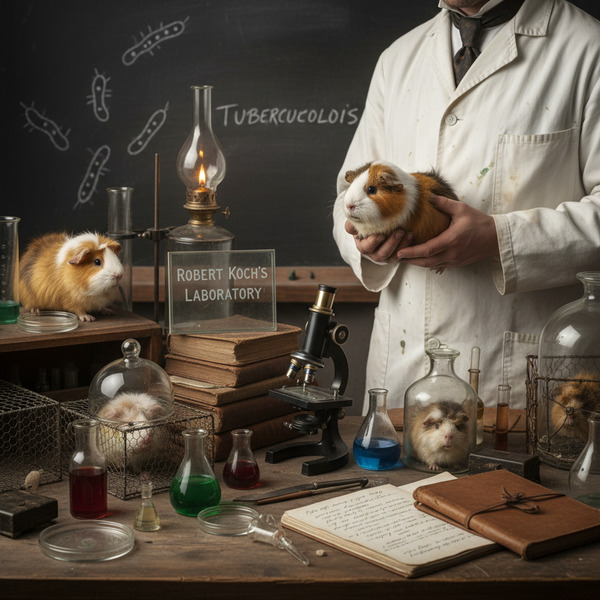
- Tuberculosis research: Robert Koch used them extensively in the 1880s to identify the bacterium causing TB (one of his famous postulates). They are highly susceptible, so low doses could induce the disease reliably.<grok:render card_id="2c4a25" card_type="citation_card" type="render_inline_citation"><argument name="citation_id">55</argument></grok:render>
- Vitamin C and scurvy: In 1907, researchers accidentally induced scurvy in guinea pigs on certain diets, helping identify the role of what became known as vitamin C (a major nutritional breakthrough, as guinea pigs—like humans—don't produce it internally).<grok:render card_id="e466bc" card_type="citation_card" type="render_inline_citation"><argument name="citation_id">46</argument></grok:render>
- Diphtheria, vaccines, and antitoxins: They were key models for developing treatments that saved many human lives.
- Other areas: Respiratory diseases (asthma, COPD), allergies, antibiotics, heart valves, blood transfusions, kidney dialysis, and more. They've contributed to at least 23 Nobel Prizes in Medicine.<grok:render card_id="6c256c" card_type="citation_card" type="render_inline_citation"><argument name="citation_id">52</argument></grok:render>
By the early 1900s, their role as a go-to "model organism" was so common that the term "guinea pig" shifted metaphorically to mean any test subject—first recorded around 1913–1920 in English for humans undergoing experiments.<grok:render card_id="82fdca" card_type="citation_card" type="render_inline_citation"><argument name="citation_id">26</argument></grok:render> It gained traction during World War eras with medical/military testing and consumer safety concerns (e.g., a 1933 bestseller called 100,000,000 Guinea Pigs criticized untested products on the public).
Today, guinea pigs are less dominant in labs (replaced by cheaper/faster-breeding mice and rats for many studies), but they're still used for specific research like infectious diseases, toxicology, and auditory/neurological work. In the U.S., tens of thousands are involved annually under regulated animal welfare rules.<grok:render card_id="7009aa" card_type="citation_card" type="render_inline_citation"><argument name="citation_id">49</argument></grok:render>
### The "Poor Creatures" Angle
Guinea pigs have endured a lot in the na…
Replies
I don't like experimentations on animals (or people for that matter). What a world we live in eh?